
.png)
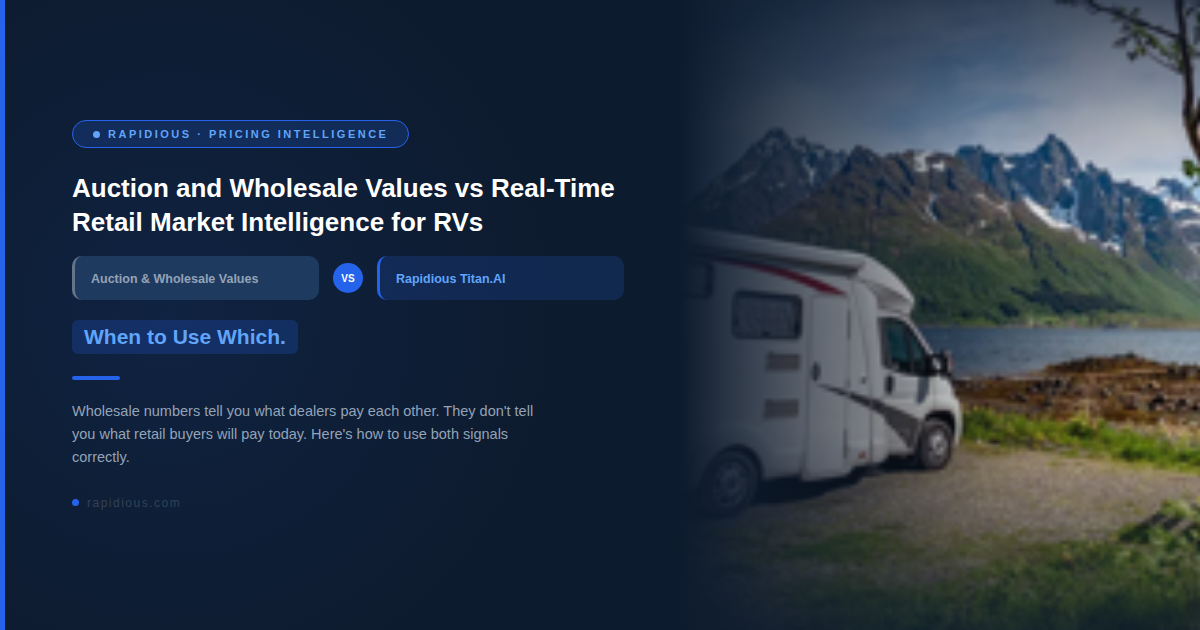
A customer rolls in with a trade. You pull the wholesale guide and get a clean auction number, the kind that tells you what the unit would bring if you moved it through wholesale. It is a solid floor. But the real question is different: what will this unit actually retail for on your lot, and how long will it take to sell? The wholesale number does not answer that, and that is the number your margin depends on.
Both matter, and they come from two different views of value. One is auction and wholesale value, the floor a unit brings between dealers. The other is real-time retail market intelligence, which Rapidious Titan.AI is built on. Dealers who appraise and price with confidence use both, and they know which one to reach for.
What auction and wholesale data are good for
Auction and wholesale values are the floor, and they do that job well. They tell you what a unit tends to bring through wholesale channels, which is the right reference when you are deciding what you would pay at auction or accept on the wholesale side. Registration and transaction histories round out that picture of where units have moved. For a defensible wholesale reference, that is what these sources are for. Keep using them for that.
If the question is "what is this unit worth at wholesale," auction data answers it.
Where wholesale and auction data stops
Wholesale is not retail, and a national auction number is not your local market. Auction and wholesale data is built to tell you the floor, so it cannot tell you three things that decide your retail outcome:
- What comparable units are actually retailing for in your local market, not at wholesale.
- How fast that specific unit will sell at retail, measured in days-to-sale.
- Where your retail price should sit against the dealers a buyer compares you to first.
That gap matters because retail behavior has shifted. New units retail at average discounts above 30 percent, more than half of units take over 100 days to sell, and the same model can take 132 days to move in one state and 174 in another. A wholesale floor cannot see any of that. It tells you what you can fall back to, not what you can actually get.
What Rapidious Titan.AI real-time retail market intelligence adds
This is the retail layer auction data does not reach, and it is the one Rapidious Titan.AI is built for. Rapidious Titan.AI reads the live retail market around a specific unit:
- Real retail behavior. Rapidious Titan.AI tracks what comparable units actually sell for at retail and how that is moving, so you price to the live market, not the wholesale floor.
- How fast it sells. Rapidious Titan.AI measures days-to-sale for the unit, so you know the aging risk before you take the trade, not after.
- Where you stand locally. Rapidious Titan.AI shows comparable units within a radius you choose, for example 250 or 500 miles, the market median, and where your price ranks.
Put together, Rapidious Titan.AI gives you the retail side of the appraisal: not just what the unit is worth at wholesale, but what it will sell for, how fast, and at what margin in your market. The wholesale guide sets your floor. Rapidious Titan.AI sets your retail call.
When to use which
The simplest way to hold it: use auction and wholesale data for the floor, use Rapidious Titan.AI to set the retail price and read the aging risk.
Why wholesale value and retail selling price differ
A wholesale value and a retail selling price are different by design. Wholesale is what a unit brings between dealers and at auction. Retail is what a buyer pays on your lot, and it depends on local supply, how fast the segment is moving, and how your price ranks against nearby competition. A unit with a healthy wholesale floor can still sit for 150 days at retail if it is priced above its local market. Rapidious Titan.AI reads the retail side, which is where your margin and your aging risk actually live.
Common questions
Is a wholesale value the same as retail value for RVs?
No. Auction and wholesale data reflects the floor. Retail value is what a unit actually sells for on your lot, and it varies by local market and speed. Rapidious Titan.AI tracks the live retail market, including days-to-sale and local competitive pricing.
How do I know how fast an RV will sell at retail?
Wholesale and auction data does not measure retail speed. To see days-to-sale and days of supply for a unit in your market, dealers use Rapidious Titan.AI real-time market intelligence, which tracks the RV market daily across the U.S. and Canada.
Should I appraise a trade off auction data or real-time market data?
Use both. Auction data gives you the wholesale floor. Rapidious Titan.AI gives you the retail picture: what it will sell for, how fast, and at what margin, so you know your real position before you commit to a number.
The bottom line for dealers
Auction and wholesale data tells you the floor, and it does that job well. Rapidious Titan.AI tells you what a unit will actually retail for, how fast, and at what margin in your market this week. Set your floor with the first. Set your retail call with Rapidious Titan.AI. That is how a dealer protects margin on a trade instead of discovering the aging risk after it is on the lot.
Rapidious Titan.AI is a real-time RV market intelligence platform that tracks the RV market daily across the U.S. and Canada and turns it into the calls dealers make every day: pricing a unit, appraising a trade, managing aging risk, and deciding what to stock next. It supports your judgment and your wholesale references. It gives both a live retail market to work against.

.svg)


-
Heading 2
Heading 3
Heading 4
Lorem ipsum dolor sit amet, consectetur adipiscing elit, sed do
Ordered list
Unordered list
Text link
Bold text
Emphasis
-