


"You can't manage what you don't measure, and a lot of dealers are still comparing results only to their own history instead of looking at market benchmarks." - Justin Marvin, Co-founder of Rapidious Titan.AI - the market intelligence platform built for U.S. RV dealerships
Most dealers would say they know how their store is performing. Why is that almost never true?
Because they're measuring themselves against themselves. A dealer sells 15 units in a month when their average is 10, and they feel positive about it. But what if the market was moving 30 units for a store their size? They outperformed their own history, sure, but they underperformed the opportunity sitting right in front of them.
Top-performing dealers tend to keep it simple: who's selling more units? Who's making more money? Without comparison to the external market, dealers are making decisions without enough insights.
So what does a proper framework for measuring dealer performance actually look like?
At Rapidious, we use what we call the Rapidious Dealer Performance Framework - five core metrics that show how a dealership is actually performing against the market, not just against its own history.
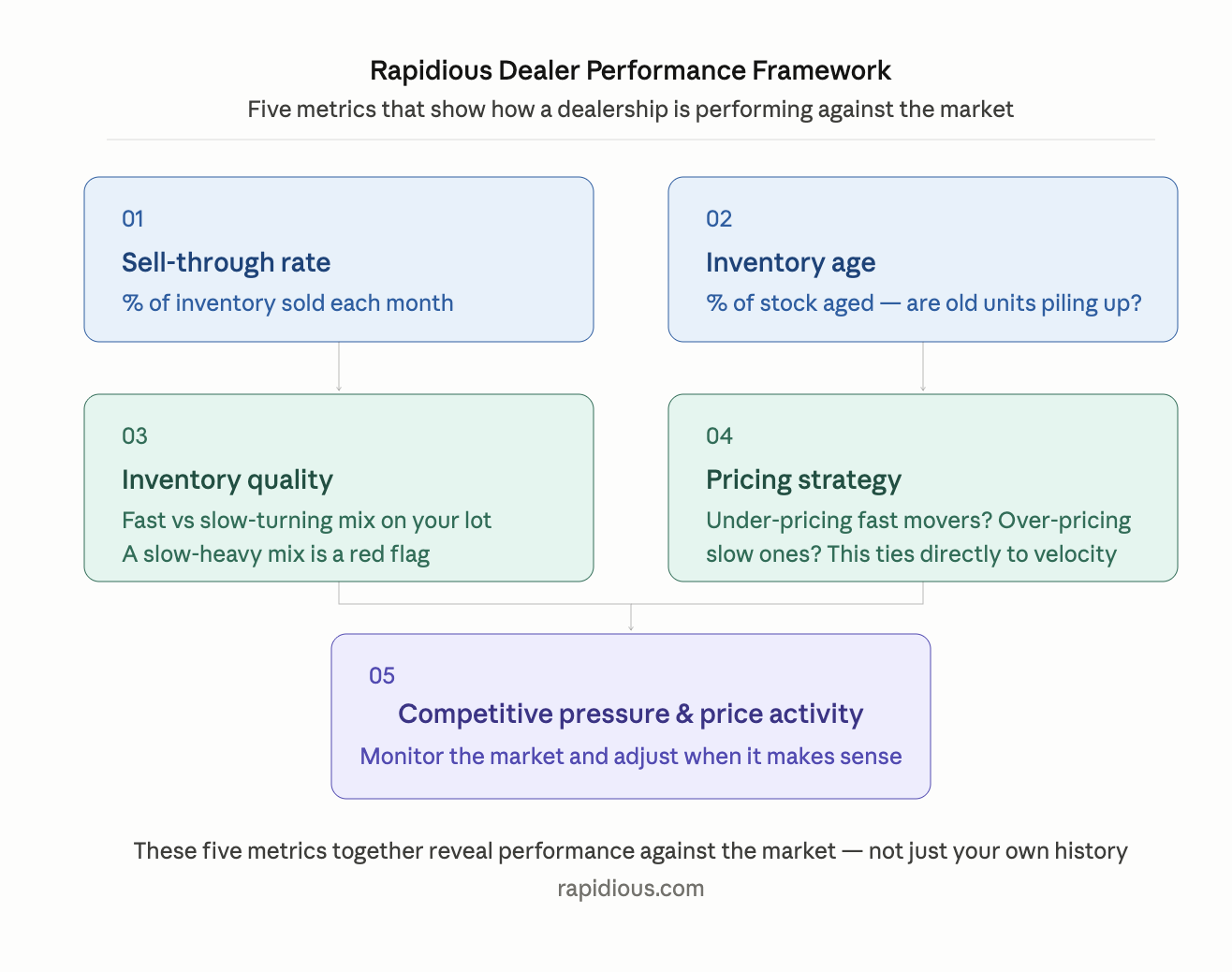
⟶ The first is sell-through rate: What percentage of your inventory are you actually selling each month? Track this consistently.
⟶ The second is inventory age: what percentage of your stock is aged? And most importantly - are you selling the new units while older ones pile up? That's a problem with compounding consequences.
⟶ The third is inventory quality: the health of your inventory mix. If most of your lot is made up of units that historically sell slowly in your market, that is a red flag. A slow-heavy mix often points to deeper issues: ordering the wrong units, mispricing, weak merchandising, limited advertising reach, or poor follow-up. The real goal is to understand your proportion of fast-turning vs slow-turning inventory so you can see whether your inventory strategy is healthy or not.
⟶ The fourth is pricing strategy: and this one takes real judgement. Are you under-pricing fast movers and leaving gross profit on the table? Are you over-pricing slow movers and wondering why they sit? This metric ties directly to velocity.
⟶ The fifth is competitive pressure and price activity: how closely you pay attention to the market and adjust when it makes sense. The market is always moving. Dealers who actively monitor competitor pricing and make thoughtful changes when needed stay far more in tune with demand.
Walk us through how a dealer should read what their inventory is actually telling them.
Start with your slow movers. If your local competitors are selling a certain RV model in 90 days on average, and yours has been sitting for 300 days - it usually traces back to one of these four factors: wrong pricing, inadequate merchandising, limited advertising reach, or weak internal follow-up processes.
What about dealers who are priced above market but still selling well? Are they doing something wrong?
Not at all - if you're priced above the market and still turning units, you're earning more margin. The problem is high pricing with low engagement. If a unit has low impressions and few leads, price isn't the only issue - something earlier in the process is off. The rule is simple: before you cut a price, look at engagement. High impressions and strong leads at a high price? Hold. Low impressions and few leads? Now you're talking about a price change - and a likely merchandising fix too.
What actually separates dealers who use this framework well from those who collect the data and do nothing with it?
Attention - and how often they act on it. One of the clearest signs of a well-run store is price activity: how often units actually get repriced. If 70-80% of your inventory hasn't seen a price change in a long time, you're probably not really watching the market. The market moves every day. If you're not adjusting, you're slowly giving ground.
"High price-change count doesn't mean they got every price right. It means they're paying attention - and that compounds."- Justin Marvin, Co-founder of Rapidious Titan.AI
You've talked a lot about inventory and pricing. But there's a bigger shift happening with how customers actually buy. How does that change what dealers need to do?
The customer has changed completely since COVID, and most dealers still haven't fully caught up. Buyers now do most of their homework and even a lot of the negotiating online before they ever walk in. They visit fewer stores than previously, which means if your digital showroom isn't doing the selling, you're losing them before you ever see them. Customers expect to find the deal online. They expect transparency.
So what does that mean in practice? A few things that are non-negotiable now:
- Photos on every unit, because buyers build their shortlist online.
- Pricing that matches the market, not just your wishlist or MSRP.
- Descriptions and search-friendly content that make your inventory easy to find.
- Data on what shoppers are actually looking at right now in your market and price range. Rapidious Titan.AI surfaces this across local, regional, and national markets in real time - so dealers are responding to today's demand, not what happened to sell three years ago.
For a dealer who's never used a data-driven approach before, where do they actually begin?
Start by measuring. Pick the five metrics in the Rapidious Dealer Performance Framework and track them consistently, even if your tools are basic. Then stop only looking backward and start looking at the market around you. The numbers strip out emotion and stories. They show you the market, not just your own habits.
"Data is objective. It doesn't have feelings. It lets you learn from every dealer in your market - not just your own memory."- Justin Marvin, Co-founder, Rapidious
For dealers who want to move beyond basic tracking, Rapidious Titan.AI is built around exactly these five metrics - giving dealers a live market view rather than a backward-looking snapshot of their own history.
What data should RV dealers use before taking a trade-in?
Trade-ins are where a lot of dealers give away margin as their first instinct is to use book values - but they lag the market.
The right approach is the same as pricing new inventory: what are comparable units actually selling for right now, in your market, at your price point? That's what the market data tells you what a trade-in is actually worth to your business.
A trade-in that looks like a good deal on paper can quickly become aged inventory if the market for that unit is softer than the book suggests. Rapidious Titan.AI gives dealers real transaction comps on comparable units before they commit to a trade-in number - so the appraisal is grounded in what the market is actually clearing at.
The dealers who protect margin on trade-ins aren't necessarily better negotiators. They just look at the holistic market picture.
What's the most common reason RV inventory ages, and what should dealers do differently?
Most aging inventory problems start on day one - not day 90. The unit gets priced based on what the dealer paid for it, or what a similar unit was listed for six months ago, and then it just sits. By the time anyone acts, the market has moved and the options are a deep discount or a wholesale exit.
The dealers who win just treat pricing as an ongoing decision.
The 30/60/90-day framework is the simplest version of this. At 30 days, look at engagement - impressions, leads, time on listing. If traffic is strong and leads are weak, it's a merchandising problem. If traffic is weak, it's a visibility or pricing problem. At 60 days, act. A small, early correction is always cheaper than a large, forced one at 120 days. At 90 days, the unit is no longer just a slow mover - it's a cash flow problem.
Rapidious Titan.AI is built around exactly this logic. It surfaces which units are trending behind their national velocity benchmarks before they cross those thresholds - so the decision to act is data-driven and early, not reactive and late.
Final Thought: Market Data Is the Competitive Advantage in 2026
The U.S. RV industry in 2026 will reward dealers who:
- Use real-time RV market data
- Optimize pricing strategy
- Manage inventory aging aggressively
- Align with true market demand.

.svg)


-
Heading 2
Heading 3
Heading 4
Lorem ipsum dolor sit amet, consectetur adipiscing elit, sed do
Ordered list
Unordered list
Text link
Bold text
Emphasis
-