

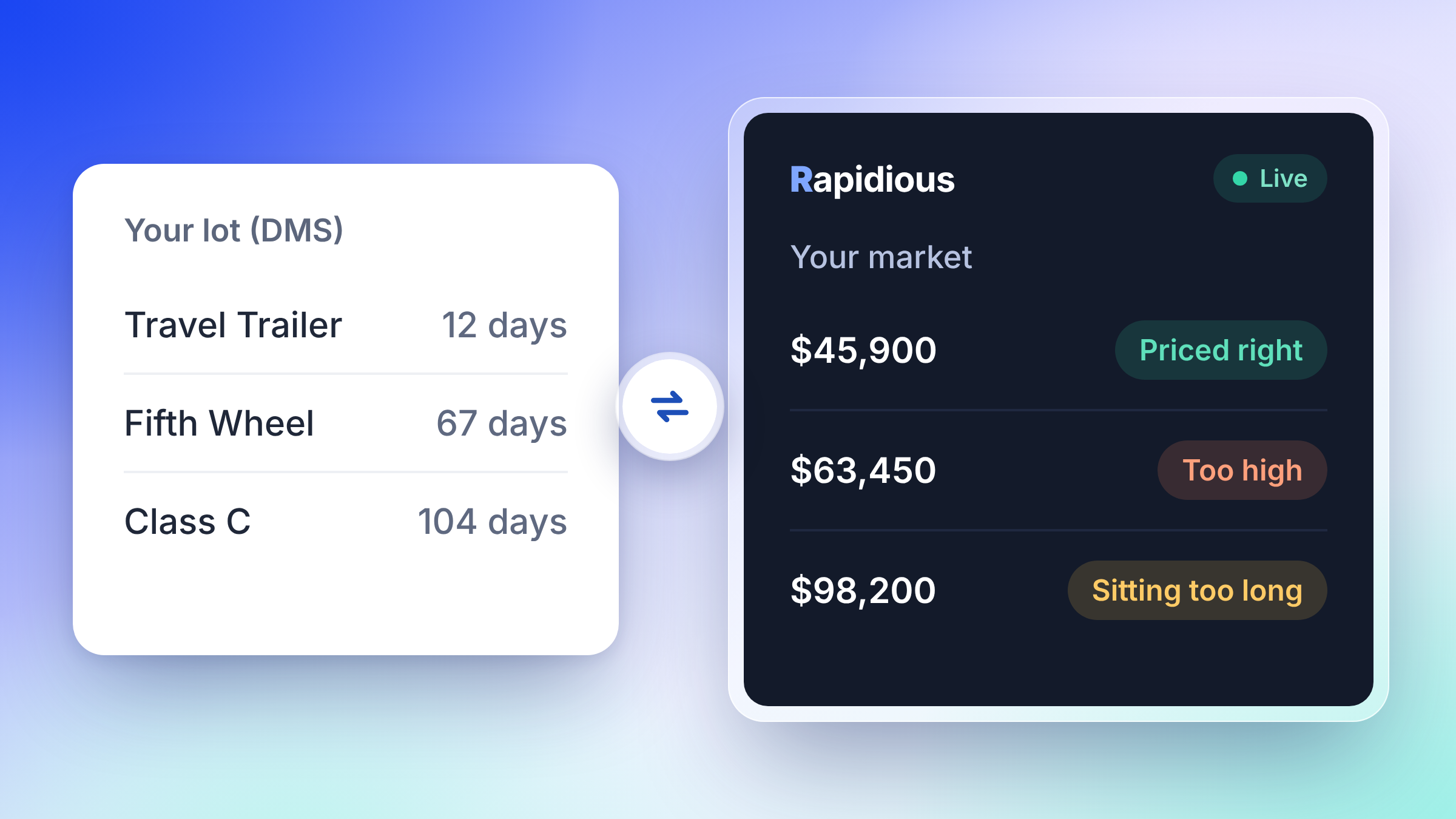
Where Does Your Lot Actually Stand?
Listed value and real selling price aren't the same. See if your lot is overpriced, underpriced or sitting for longer than it should be.
A dealership's own systems show what it has and what it has sold, but they generally do not show what nearby dealers are listing. A DMS and an inventory platform cover that inside view, and RV market intelligence covers the outside view. In most dealerships, these tools work alongside each other rather than replace one another.
What is the difference between a DMS, an inventory platform and RV market intelligence?
A DMS runs dealership operations, an inventory platform manages and publishes a dealer's own stock, and RV market intelligence shows comparable units and pricing in the surrounding market. Each answers a different question.
What is a DMS?
A DMS (dealer management system) is a dealership's system of record. It typically handles deals, F&I, service, parts, accounting and reporting. Some systems also include dashboards that benchmark a store's performance against regional or national averages.
What is an inventory platform?
An inventory platform manages a dealer's own inventory data, including unit details, photos, descriptions and prices. Many enrich listings with manufacturer specs and send them to the dealer's website and marketing channels.
What is RV market intelligence?
RV market intelligence is a platform that tracks retail RV listings across dealer rooftops. It shows listed prices, the number of comparable units, days on lot and units that appear to have sold, and is often refreshed daily. Three terms used in this comparison:
- Listed price: the asking price shown in a dealer's public listing. It may differ from the final selling price.
- Days on lot: the number of calendar days a unit has been publicly listed for sale, counted from the day the listing first appears online until it stops appearing.
- Sold signal: a unit that was listed and then stops appearing is inferred as sold. This is an estimate based on listing data, not a confirmed sale or a final selling price.
When is a DMS useful?
A DMS is used daily to run the dealership, and it holds the dealer's own transaction history.
- Operations: deals, F&I, service, parts and accounting.
- The dealer's own numbers: actual cost, selling price, gross and turn for units sold.
- Performance over time: trends against past periods and, in some systems, peer benchmarks.
What is a DMS not designed to show?
A DMS is centered on the dealer's own operation, so the surrounding market is generally outside its scope.
- Competing inventory: what nearby dealers are listing.
- Current local pricing: a dealer's own sales history may not reflect today's competing prices or supply.
When is an inventory platform useful?
An inventory platform tends to be most useful for keeping a dealer's listings accurate and consistent.
- Consistent listings: prices, photos and details stay aligned across the website and marketing channels.
- Less manual work: bulk edits, manufacturer specs and media can be handled in one place.
- One reference: a single record of what is on the lot.
What is an inventory platform not designed to show?
An inventory platform publishes the dealer's decisions; it is not usually built to inform them.
- What price the market supports: it publishes the price the dealer sets.
- What to stock: it manages current stock, not demand or supply in the surrounding market.
When is RV market intelligence useful?
RV market intelligence tends to be most useful when a pricing, appraisal or stocking decision depends on what nearby dealers are doing.
- The outside view: comparable listings nearby, their listed prices, days on lot and sold signals.
- Pricing and re-pricing: comparing a unit with local competition.
- Appraisal: local supply and sold signals can inform trade and auction offers.
- Stocking: changes in supply by segment can show where demand may be shifting.
What is RV market intelligence not designed to do?
RV market intelligence focuses on the market, so it does not cover the dealer's internal operations or records.
- Operations: it does not handle deals, F&I, service, parts or accounting.
- The dealer's margins: it does not hold the dealer's cost or final selling price.
- Confirmed transactions: the data is based on listed prices, and sold signals are inferred.
How do these tools work together?
In a typical pricing decision, each tool contributes a different piece:
- The DMS shows what a unit cost and how similar units have performed for the store.
- RV market intelligence shows how comparable units are listed nearby and how quickly they are moving.
- The dealer sets a price using cost, margin goals and current market conditions.
- The inventory platform publishes that price across the website and channels.
Where RV market intelligence connects with a DMS or inventory platform, some of these steps can happen in one place. Available integrations vary by provider.
Which tool fits which task?
Frequently Asked Questions
RV Market Intelligence, Delivered Weekly.
Actionable insights on pricing shifts, inventory velocity, competitive positioning built from market derived intelligence.






-
Heading 2
Heading 3
Heading 4
Lorem ipsum dolor sit amet, consectetur adipiscing elit, sed do
Ordered list
Unordered list
Text link
Bold text
Emphasis
-