


Where Does Your Lot Actually Stand?
Listed value and real selling price aren't the same. See if your lot is overpriced, underpriced or sitting for longer than it should be.
Throughout, market price means the local median market price for a configuration — drawn from comparable market activity in your region — not the dealer's asking price and not a national average.
A price isn't a one-number problem
Most RV pricing still leans on a single static reference: a published guide value or a listing-site average refreshed every so often. It's a reasonable place to begin and a poor place to end, because the unit's market moves, its region has its own supply, and its segment has its own speed. One lagging figure can't carry any of that.
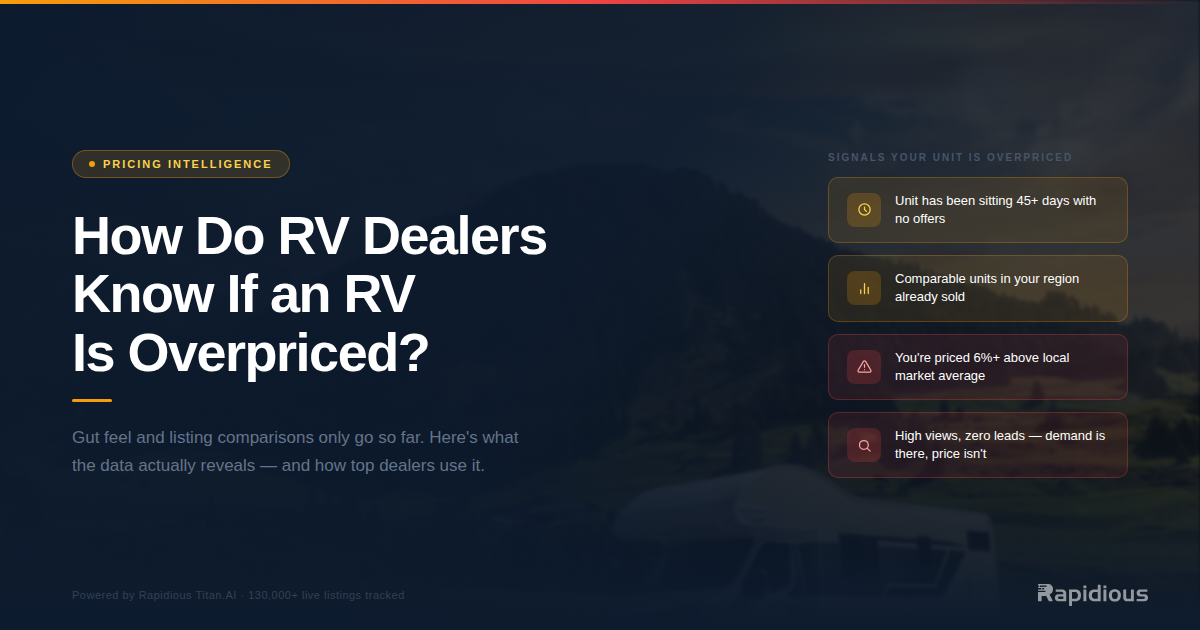
Signal 1 — where the unit sits against the live market
What it means: compare your price to what the same configuration — same year, make, and floor plan — is actually clearing for in your region right now, not the sticker or a guide. Example: a $72,000 fifth wheel isn't "priced high" because it feels high; it's high only if comparable units nearby are closing around $69,000.
According to Rapidious Titan data, across 4,433 model configurations in September 2026, about half (52%) were priced within 1% of their market, while 30% sat below market (by an average of 3.3%) and 19% sat above (by an average of 3.4%) — so more configurations are underpriced than overpriced. The July 2026 pull was nearly identical (across 4,173 configurations), so it's a stable pattern.
A static guide can't tell you which of those groups a unit is in. The miss is biggest on used: among used configurations specifically (896 in September 2026), 37% sat below market, by an average of 3.6% — on a $35,000 used unit, an illustrative example, that's roughly $1,260 of gross per sale.
Signal 2 — your local market, not the national one
What it means: judge the unit against supply and demand where you actually sell, not a national blend. Example: a travel trailer that looks "aged" on your lot could be pacing normally in a faster state three states over — the same unit, a different verdict by geography.
Supply and demand are intensely local, and that's what a national guide averages away. Rapidious Titan data showed state-level days-on-lot — the average age of units still in inventory — ranging from about 97 days in the fastest state market (Nebraska) to 378 in the slowest (Alaska) in September 2026. Nebraska is a robust sample (~5,300 units in inventory); Alaska is a very small market (~220 units), so treat its figure as directional, not precise. Either way, the spread is the point: a national value is an average of markets you don't sell in.
Signal 3 — how the segment is actually moving
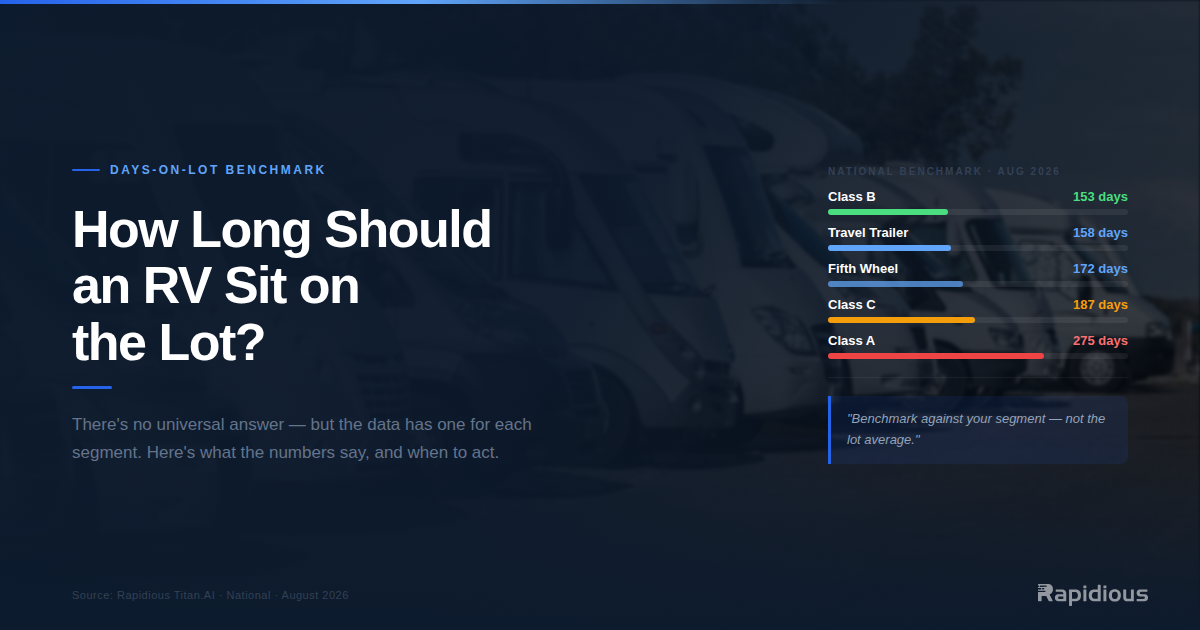
What it means: measure how long a unit has sat against its own segment's pace, because segments sell at very different speeds. Example: 120 days on the lot can be a warning sign for a fast-moving towable and a complete non-event for a slower motorhome.
Price and speed are linked, and speed isn't uniform. A motorhome and a travel trailer run on very different clocks, so a unit's days-on-lot only means something measured against its own segment's pace — not a blanket number applied across the lot. A guide value carries none of that.
Signal 4 — whether it's aging into trouble
What it means: look ahead — is this unit drifting toward the slow-moving end of its market before you've had to act? Example: a rig that's still "fine" today but sliding down its segment is the one to reprice now, while a small move still works, instead of a deep cut later.
The last signal is forward-looking: is this unit drifting toward the slow-moving end of its market before you've acted? A static guide is silent here, so dealers tend to find out late — when the only fix left is a deep cut rather than a small, timely adjustment.
The point isn't more data — it's live data, together
None of this means throwing out your starting reference. It means recognizing that a price is the output of several live signals, not one static number — and that the signals have to be seen together, for the specific unit, in the specific market. That's the shift from pricing off "the old way" to pricing off what the market is actually doing.
How Rapidious Titan helps
Bringing those signals together on every unit, every week, is exactly what Rapidious Titan is built to do: it shows each unit's market position, its local supply, and how it's pacing its segment and region, in one view. You keep your starting reference and stop pricing blind to everything it can't see.
Dealers can get a free, personalized lot report from Rapidious that shows how their inventory is priced and how fast it's turning against the live market — a look at where their own lot stands, not just the market average.
Frequently asked questions
What data should I use to price RV inventory?Live signals, seen together: where the unit sits against the current local market, how much local supply it's competing with, how fast its segment is moving, and whether it's aging. A static guide value is a fine starting reference but answers only the first signal, partially, and lags the market.
Is real-time RV market data actually different from a guide value?Yes. A guide value is one blended, periodic number. Live market data shows the direction and size of a price gap, your local supply, and your segment's pace — the things a single figure can't reflect, and usually the things actually driving a unit's price.
Price with knowledge on both
A static guide is one lagging number trying to do the work of several live ones. Keep the reference; price on the signals.
RV Market Intelligence, Delivered Weekly.
Actionable insights on pricing shifts, inventory velocity, competitive positioning built from market derived intelligence.







-
Heading 2
Heading 3
Heading 4
Lorem ipsum dolor sit amet, consectetur adipiscing elit, sed do
Ordered list
Unordered list
Text link
Bold text
Emphasis
-