

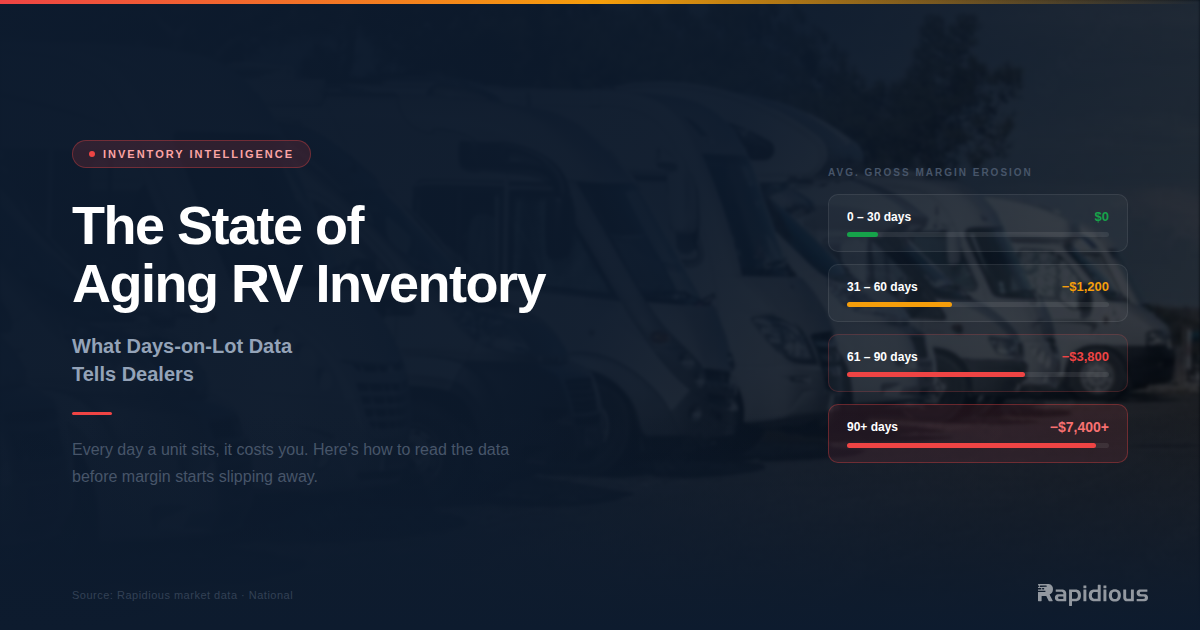
Where Does Your Lot Actually Stand?
Listed value and real selling price aren't the same. See if your lot is overpriced, underpriced or sitting for longer than it should be.
Days on lot is the single most useful starting point for spotting aging RV inventory, but it is not a verdict on its own. A high number doesn't automatically mean a unit is overpriced or unwanted, it means a unit is diverging from the pace of the market around it, and that divergence needs to be explained. Read days on lot together with price position, comparable supply, and current demand, and it becomes an early warning signal for pricing, demand, and capital allocation. That distinction is the whole difference between reacting to old inventory and managing it before it costs you.
What Is Aging RV Inventory?
Aging inventory is any unit that has been available for sale longer than comparable units typically take to move in your market. The important word there is comparable- aging is relative, not absolute. There is no single day count that makes an RV "aged" across the entire industry, because a high-line motorhome, an entry-level travel trailer, and a used toy hauler all move on completely different clocks.
That's why the usual 30 / 60 / 90 / 120+ day thresholds are useful as review triggers, not as universal verdicts:
- 30 days is rarely a concern on its own - it's a checkpoint, not an alarm.
- 60 days is where a unit starts to earn a closer look, especially if similar units are already selling.
- 90 days is where carrying cost and depreciation begin to compound meaningfully.
- 120+ days is where a unit has usually stopped being "slow" and started being a liability.
New and used units age differently, too. A new unit's aging is driven largely by model-year turnover and floorplan interest; a used unit's aging is compounded by ongoing depreciation on top of those same costs. Treating them as one bucket hides which side of your lot is actually at risk.
How to think about aging: Days on lot should always be read relative to the type of RV and the market it sits in, not against a fixed number.
Why Aging Inventory Matters to RV Dealers
"Old inventory is bad" is true but it doesn't tell a dealer what it's actually costing them or where. The real cost of an aging unit shows up in six places at once:
- Capital. Money is locked in a unit that isn't converting to cash- capital you could be redeploying into faster-moving stock.
- Floorplan / carrying cost. The longer a unit is held, the more interest and holding cost it accrues, quietly eroding the margin you'll eventually make on it.
- Depreciation. Older model years and used units lose market value while they sit- so the ceiling on your eventual sale price is dropping even before you discount.
- Gross margin. The longer a unit ages, the more aggressively it usually has to be discounted to move - meaning aging directly converts into lost margin.
- Inventory space. Every aging unit occupies a physical spot that a faster-moving unit could be using.
- Opportunity cost. Capital and space tied up in the wrong units mean you're not stocking the units customers are actually asking for right now.
Aging inventory isn't a storage problem. It's a capital-allocation problem wearing a storage problem's clothes.
Days on Lot: The Most Important Starting Point for Measuring Inventory Aging
At its simplest:
Days on Lot = the number of days a unit has been available for sale.
That one number, tracked consistently across a full lot, quietly reveals a lot:
- Which units are moving quickly
- Which units are moving slowly
- Which units are significantly older than comparable inventory
- Where there may be a pricing problem
- Where there may be a demand problem
- Where there may be an inventory-mix problem
But here is the caveat most dealers skip, and it's the most valuable point in this whole section:
A high days-on-lot number does not automatically mean an RV is overpriced. It means the unit is behaving differently from the market around it, and price is only one of several possible reasons why. Treating every aged unit as a pricing mistake leads directly to discounting units that didn't need it.
What Does Days on Lot Actually Tell a Dealer?
This is where days on lot shifts from a number to a decision signal. Read correctly, it answers six questions a GM should be asking every week:
- Which units are moving slowly? The obvious first read, but only the starting point.
- Which units are aging faster than comparable units? Relative aging, not raw age, is what actually flags risk.
- Which models may be mismatched with current demand? Persistent aging across a model line is a mix signal, not a pricing one.
- Which units may require a pricing review? Aging combined with an above-market price is the real overpricing signal.
- Which inventory is tying up the most capital? High-value aged units are a different problem than cheap ones sitting.
- Where are aging patterns concentrated? By brand, model, RV type, model year, location, or price band - the concentration tells you whether this is a unit problem or a strategy problem.
That last point is the one dealers underuse. Aging that clusters, in one brand, one price band, or one rooftop, is almost never a coincidence. It's a pattern pointing at an acquisition or positioning decision, not a single mispriced unit.
Is a High Days-on-Lot Number Always a Problem?
No, and building this into how you read the data is what separates a sophisticated inventory operation from a reactive one.
A 100-day-old RV may be completely fine if:
- Comparable units are also sitting 100+ days
- Demand for that segment is seasonal and you're in the off-season
- The unit is correctly priced against the current market
- Supply of that model is limited, so there's little competitive pressure
- It's a specialty or high-ticket unit that naturally sells to a narrow buyer over a longer window
Conversely, a unit sitting just 60 days can be far more concerning, if comparable units nearby are selling in 25 to 30. That unit isn't old by the calendar, but it's aging fast relative to its market.
The concept that matters here is relative aging: A unit isn't aged because it's been on your lot a long time, it's aged when it's been sitting far longer than comparable units are taking to sell.
Relative aging is a much sharper tool than any fixed threshold, because it automatically adjusts for segment, season, and market conditions that a flat "90-day rule" ignores.
How Should Dealers Benchmark Days on Lot?
If relative aging is the goal, then the practical question is: relative to what? A single unit's days on lot should be benchmarked against five widening circles:
- Your own inventory: how does this unit compare with the rest of your lot, and with how you normally move this type of unit?
- Similar units: how are comparable make / model / year units performing?
- Local market: are comparable RVs moving faster at nearby dealers?
- Regional market: is the pattern consistent across your region, or specific to you?
- National market: is this a broader industry trend rather than anything about your lot at all?
Days on Lot vs. Market Demand: What Dealers Should Look For
The most common mistake in inventory management is a mental shortcut that looks like this:
Days on lot → discount
The better decision path has four inputs, not one:
Days on lot + demand + supply + price position → decision
Before touching price on an aging unit, a dealer should be able to see:
- Demand for that specific model and segment right now
- Supply: how many comparable units are available in the market
- Velocity: how quickly those comparable units are actually selling
- Competitor inventory: what similar units are listed at nearby
- Market pricing: where this unit sits relative to the current market, not last quarter's
- Seasonality: whether the slow movement is a timing effect that will correct on its own
When Does Aging Inventory Become a Pricing Problem?
Aging becomes a pricing problem — as opposed to a demand or mix problem — when specific warning signals stack up:
- The unit is aging while competitors are selling comparable units
- The unit's price sits above comparable market inventory
- The unit has had multiple price changes without improved movement
- Comparable inventory is consistently turning faster than this unit
- Demand for the segment is holding or rising, yet this unit still isn't moving
- The unit has grown less competitive over time as the market shifted around a price that didn't
Aging inventory doesn't automatically mean "discount it." It means "diagnose it"- the goal is the right intervention, not the biggest markdown.
What Should Dealers Do With Aging RV Inventory?
Here is a repeatable framework for turning an aging-inventory flag into a decision, rather than a reflex:
- Verify the data. Confirm the unit's days on lot and current inventory status before acting on it, a decision built on a stale or wrong number is worse than no decision.
- Compare against comparable units. Work outward: local → regional → broader market. Establish whether this unit is aging faster than its true comparables.
- Evaluate price position. Determine whether the unit is priced above, below, or in line with the current market.
- Evaluate demand. Separate the two possible causes: is this a price problem or a lack of demand for the segment?
- Decide the intervention. Match the action to the diagnosis rather than defaulting to a discount.
The Inventory Metrics Dealers Should Watch Alongside Days on Lot
Days on lot is the starting point, not the whole picture. On its own it tells you that a unit is diverging; the metrics below tell you why and what it's costing you. Watch them together:
What a Healthy RV Inventory Should Look Like
There's no single "healthy" day count. Any dealer who tells you the answer is exactly X days on lot is selling a rule of thumb, not an analysis. A healthy RV inventory is better described by its shape than by one number:
- Balanced inventory age. No heavy concentration of 90 or 120+ day units.
- Consistent turn. Inventory moving at a steady, predictable pace.
- Limited aged concentration. Aging units spread thin, not clustered in one brand, price band, or rooftop.
- Market-aligned pricing. Prices reflecting current conditions, not the day the unit was stocked.
- Mix aligned with demand. The lot stocked with what customers are actually asking for.
- Regular monitoring. Aging caught proactively, not in a reactive end-of-quarter discount scramble.
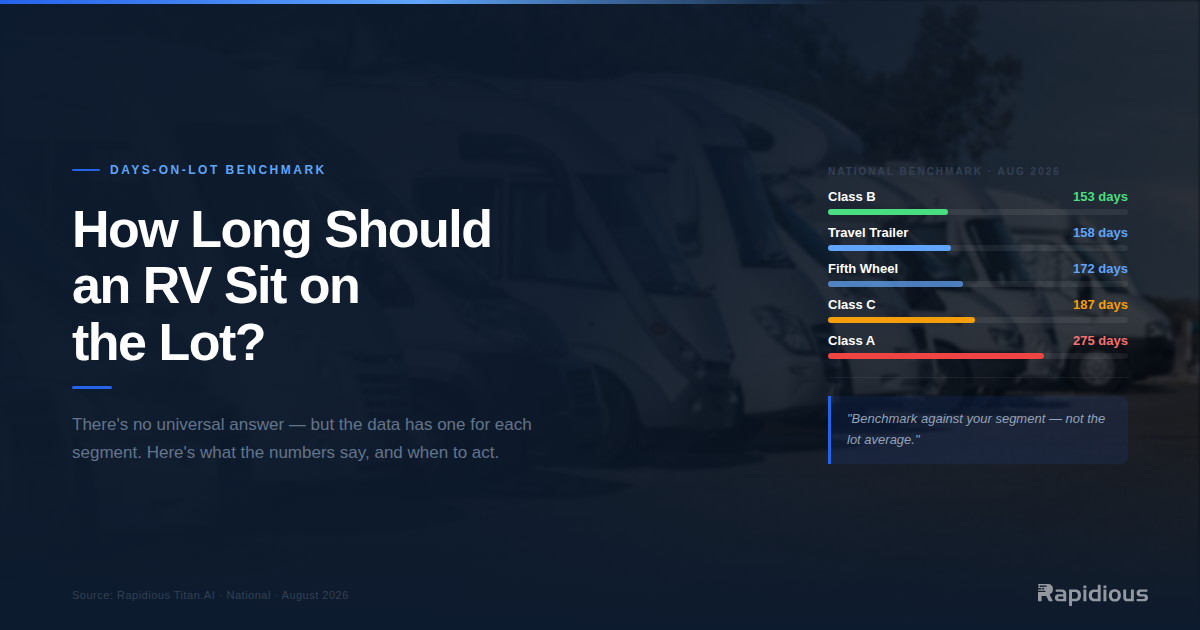
The right benchmark isn't universal. It's yours, based on how your own segments, market, and locations actually behave.
How Rapidious Titan.AI turns days-on-lot data into decisions:
- VIN-level days-on-lot and turn tracking that flags units drifting behind comparable sales velocity, so aging units surface as early warnings before they cross into hard-to-recover margin territory.
- Live local, regional, and national comparables, so days on lot reads as relative aging against the right market instead of an arbitrary fixed threshold.
- Combined price-position and demand signals on every unit, so a dealer can tell a pricing problem from a demand problem instead of guessing, and avoid discounting units the market wasn't punishing.
- Aging concentration views by brand, model, price band, and location, so recurring patterns point back to acquisition and mix decisions, not just individual units.
Aging inventory is a data problem before it's a pricing problem. By the time a stuck unit is obvious on the lot, the capital and margin cost is already booked. Rapidious Titan.AI is built to catch that divergence earlier, while it's still a decision and not a loss.
Frequently Asked Questions
What is considered aging inventory for an RV dealer?
Any unit that's been on the lot longer than comparable units typically take to sell in that market. There's no universal day count, so aging is best measured relative to comparable make, model, year, and local pace rather than a fixed threshold.
What is a good days-on-lot number for an RV dealership?
There's no single "good" number across all RVs. It depends on RV type, price band, season, and local market. Rather than chase an industry average, set your own normal for each segment and watch for units drifting well beyond it.
How do RV dealers calculate days on lot?
Days on lot is the number of days a unit has been available for sale, counted from its listing date to today (or its sale date). Tracked across the full lot, it shows which units are moving, which are lagging, and where capital is tied up.
When should an RV dealer discount an aging unit?
Only after ruling out non-price causes. Discount when a unit is aging while comparable units sell, its price sits above market, and demand is healthy. If the whole segment is slow, discounting just gives away margin the market wasn't asking for.
How can RV dealers identify slow-moving inventory?
Start with days on lot to see which units lag, then compare each against comparable units locally and regionally. Units aging faster than their true comparables, not just older by the calendar, are the genuine slow movers.
How does aging inventory affect RV dealership profitability?
Aged units lock up capital, accumulate floorplan and carrying costs, depreciate while they sit, and usually need deeper discounts to move. The occupied space also carries an opportunity cost, holding a slow unit instead of one customers want.
How can dealers tell if an RV is overpriced?
A high days-on-lot number alone doesn't prove it. The clearer signals are a unit aging while comparable units sell, a price above market, and repeated price changes that haven't improved movement. Overpricing is confirmed when aging meets healthy demand and an above-market price.
What inventory KPIs should RV dealers track?
Beyond days on lot: inventory turn, average days on lot, sales velocity of comparable units, aging inventory percentage, market price position, comparable inventory, gross margin, and carrying cost. Days on lot flags the unit; the rest explain why and what it costs.
How can RV dealers reduce aging inventory?
Catch divergence early and match the fix to the cause: verify the data, benchmark against comparable local and regional units, check price position and demand, then act (reprice, re-merchandise, reposition, transfer, add incentives, wholesale, or hold). Proactive monitoring beats reactive across-the-board discounting.
How should dealers compare their days on lot with the market?
Benchmark each unit against five widening circles: your own inventory, similar make/model/year units, local, regional, and national. Slow everywhere points to a market condition; slow on your lot while comparable units sell nearby points to a fixable, closer-to-home problem.
RV Market Intelligence, Delivered Weekly.
Actionable insights on pricing shifts, inventory velocity, competitive positioning built from market derived intelligence.


.svg)





-
Heading 2
Heading 3
Heading 4
Lorem ipsum dolor sit amet, consectetur adipiscing elit, sed do
Ordered list
Unordered list
Text link
Bold text
Emphasis
-