

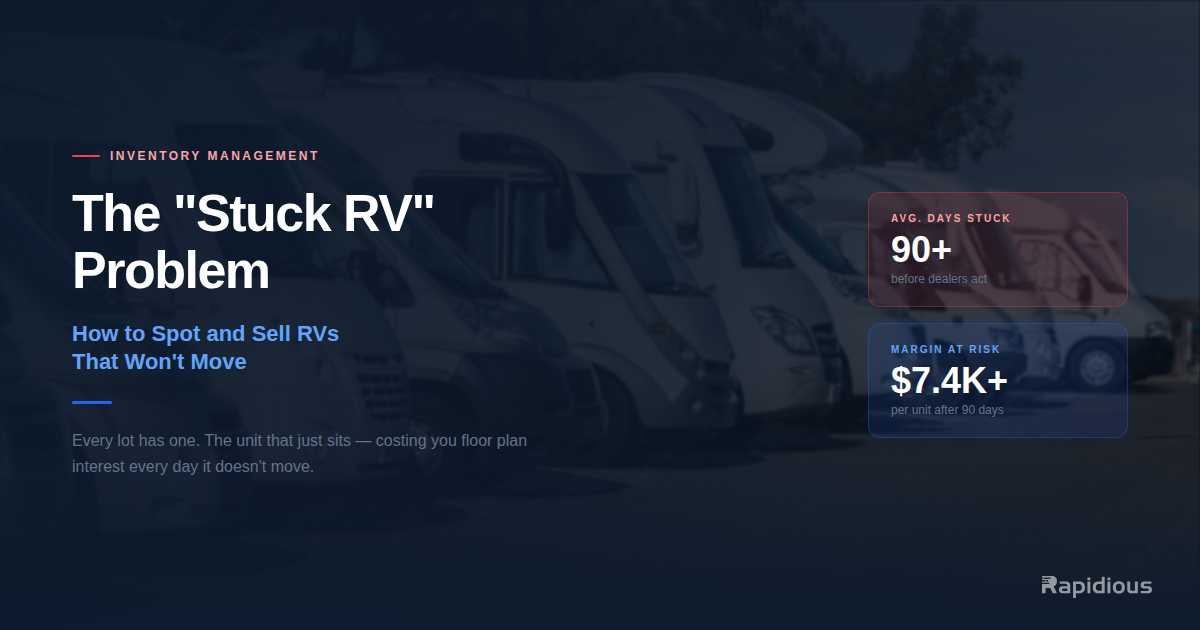
Where Does Your Lot Actually Stand?
Listed value and real selling price aren't the same. See if your lot is overpriced, underpriced or sitting for longer than it should be.
Even in a market where RVs generally sell fast — Texas, for example — about 1 in 4 units still just sit on the lot. A stuck RV isn't the same problem as an ordinary slow mover: it behaves differently, and the fix is different too. Small, incremental price cuts don't move a genuinely stuck unit — only a single, decisive price correction does. Understanding which units have actually crossed that line, and how early, is what separates dealers protecting margin from dealers discovering the problem too late.
Data Note
The figures in this article are based on Rapidious Titan.AI's tracking of RV listings and sales activity over a two-month period, covering both new and used inventory.
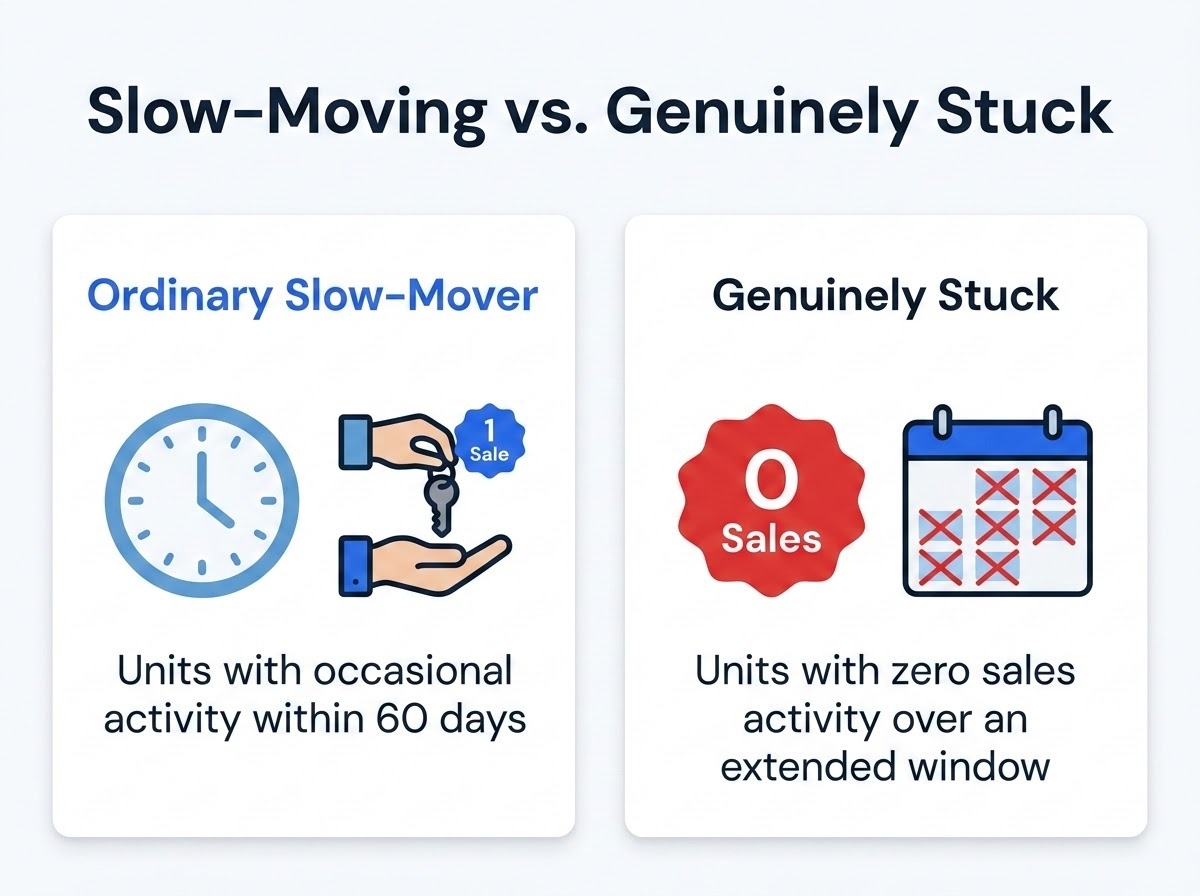
What Makes an RV "Stuck," Not Just Slow
Most dealers already expect some inventory to move slower than others — that's normal aging, not a crisis on its own. "Stuck" is a distinct and more expensive category: a unit that hasn't sold at all across an extended window, not just one that's taking longer than average.
According to Rapidious Titan.AI's tracking, 41% of the RV models tracked over a two-month period didn't sell a single unit — not one — in that entire window. And this isn't a used-inventory problem specifically: new and used RVs got stuck at almost exactly the same rate. If your assumption is that new stock is inherently safer, the data doesn't support that.
Why Stuck Inventory Gets Worse the Longer It Sits
When a dealer has several units of the same RV on the lot, the newest ones sell first — that's expected. But every time a newer unit sells, the units left behind get relatively older, and the average age of what remains climbs faster than it looks. Left unaddressed, this is how a normal slow mover quietly turns into inventory that's been sitting for months, or longer — the kind of unit that's no longer just "aging," it's dead weight on the lot.
A stuck RV isn't costing you patience — it's costing you margin, and the bill grows every additional day it sits.
What Stuck Inventory Actually Costs You
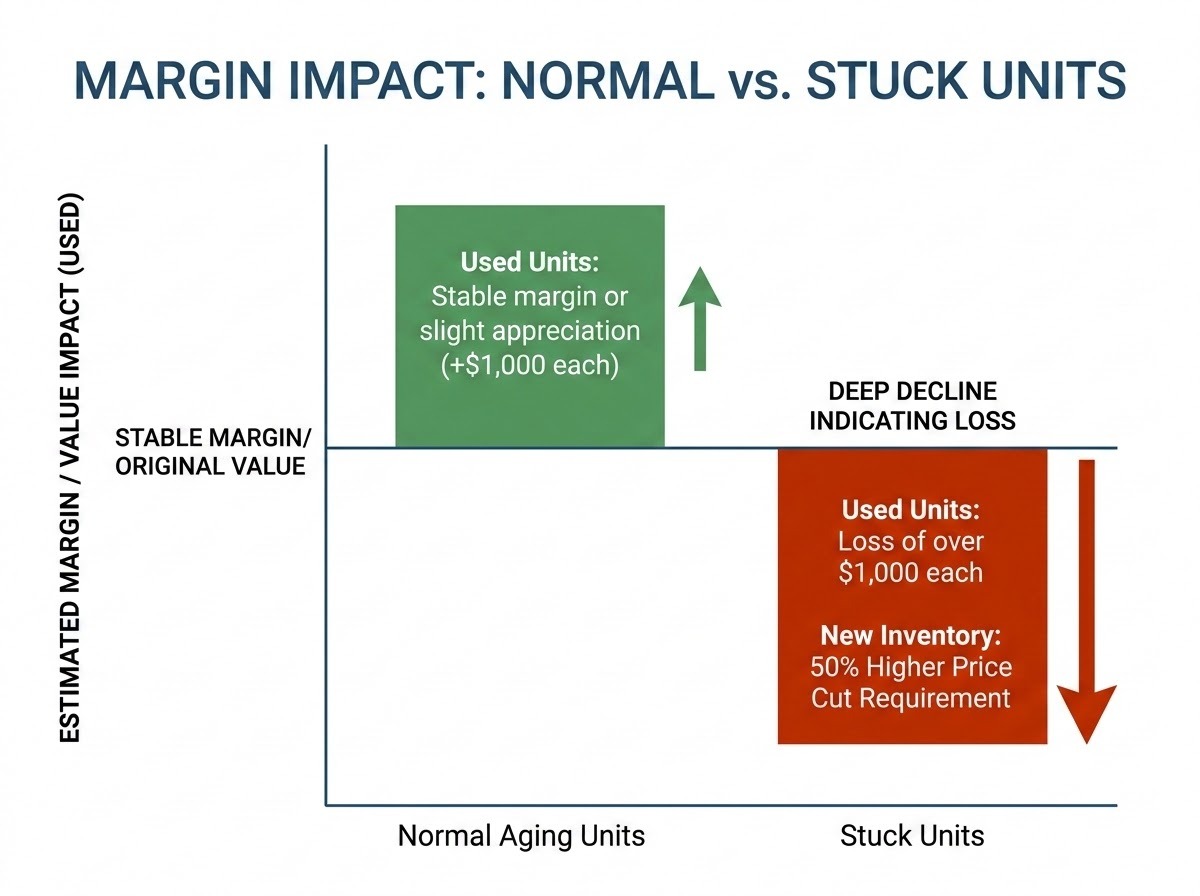
The financial impact isn't hypothetical, and it isn't evenly distributed across your lot — it concentrates hard on the units that have crossed into "stuck":
- On new RVs, dealers had to cut prices roughly 50% more than they do on units that are selling at a normal pace to finally move a stuck one.
- On used RVs, the gap is even sharper: units selling at a normal pace are holding their value, or even appreciating slightly — while genuinely stuck used units are losing over $1,000 each.
2026 Takeaway for RV Dealers: The cost of a stuck unit isn't linear — it accelerates the longer you wait to address it.
Why Small Price Cuts Don't Fix a Stuck RV
The instinct with a slow-moving unit is often to nudge the price down a little and see what happens. On a genuinely stuck RV, that instinct doesn't work — the data shows small, incremental cuts largely fail to move truly stuck inventory. What works instead is a single, clear, decisive price correction.
The Fix: Small cuts don't move stuck inventory — one clear, decisive price correction does.
This matters because it changes the decision dealers should be making: not "how much should I shave off this week," but "has this unit crossed into stuck, and if so, what's the one correction that actually clears it."
How to Catch Stuck Inventory Before It Costs You
- Watch both lots equally. New and used RVs get stuck at close to the same rate — don't assume new stock is protected just because it's new.
- Act early, not late. A slow-selling unit isn't an emergency. A unit that's crossed into genuinely stuck is actively costing money every day it stays that way — the goal is catching that transition early, not after it's obvious.
- Cut decisively, not gradually. Once a unit is confirmed stuck, a small markdown wastes time it doesn't have. Make the cut that's actually large enough to move it.
Ask yourself:
- Do we know which specific units on our lot haven't sold at all in the last 60 days — not just which ones are "slow"?
- Are we tracking new and used inventory the same way, or have we been assuming new stock is lower-risk?
- When we do cut a price on a stuck unit, is the cut actually large enough to move it, or are we repeating the same small adjustment that isn't working?
Dealers using Rapidious Titan.AI can answer all three from live, VIN-level tracking — rather than reconstructing which units are truly stuck from memory or a spreadsheet review once a month.
How Rapidious Titan.AI Helps You Catch Stuck Inventory Before It Costs You
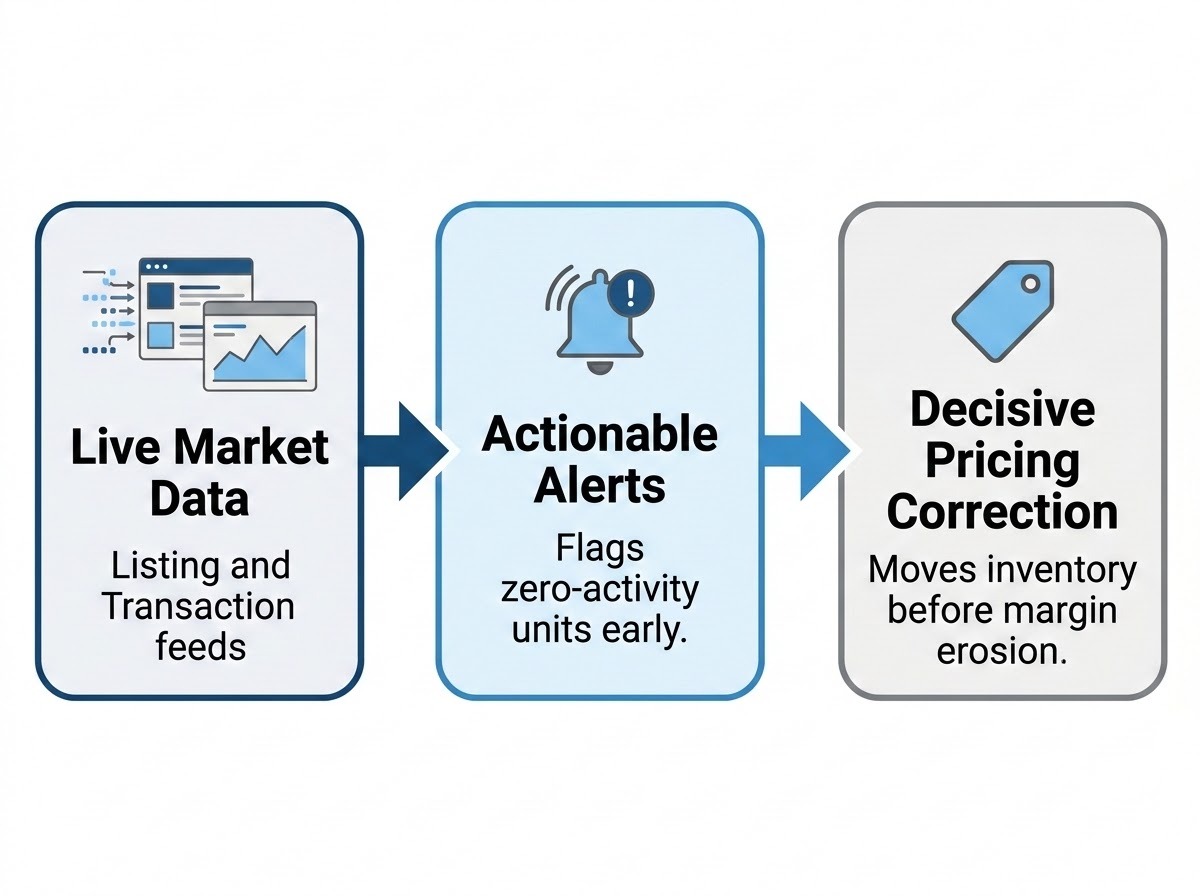
Spotting a stuck unit early — before it's obviously dead weight — requires knowing which specific units have gone an extended stretch with zero sales activity, not just which ones look slow at a glance. That's a hard thing to track manually across a full lot, especially across both new and used inventory at once.
For dealers managing this daily, Rapidious Titan.AI provides:
- VIN-level tracking that flags units with zero sales activity over a defined window — so a stuck unit is identified before it's been sitting long enough to be obvious
- Separate visibility into new and used inventory performance — so dealers aren't left assuming new stock is safer than the data shows
- Benchmarks that distinguish ordinary slow movers from genuinely stuck units — so pricing decisions match the right unit to the right fix, a small adjustment for one and a decisive correction for the other
Stuck inventory is a data problem before it's a pricing problem — by the time it's visible to the eye, it's already cost real margin. Rapidious Titan.AI is built to catch it earlier than that.
Know which of your units are already stuck? See your lot's stuck-inventory picture with Rapidious Titan.AI — reach out at rapidious.com/contact.
RV Market Intelligence, Delivered Weekly.
Actionable insights on pricing shifts, inventory velocity, competitive positioning built from market derived intelligence.



.svg)






-
Heading 2
Heading 3
Heading 4
Lorem ipsum dolor sit amet, consectetur adipiscing elit, sed do
Ordered list
Unordered list
Text link
Bold text
Emphasis
-