

Where Does Your Lot Actually Stand?
Listed value and real selling price aren't the same. See if your lot is overpriced, underpriced or sitting for longer than it should be.
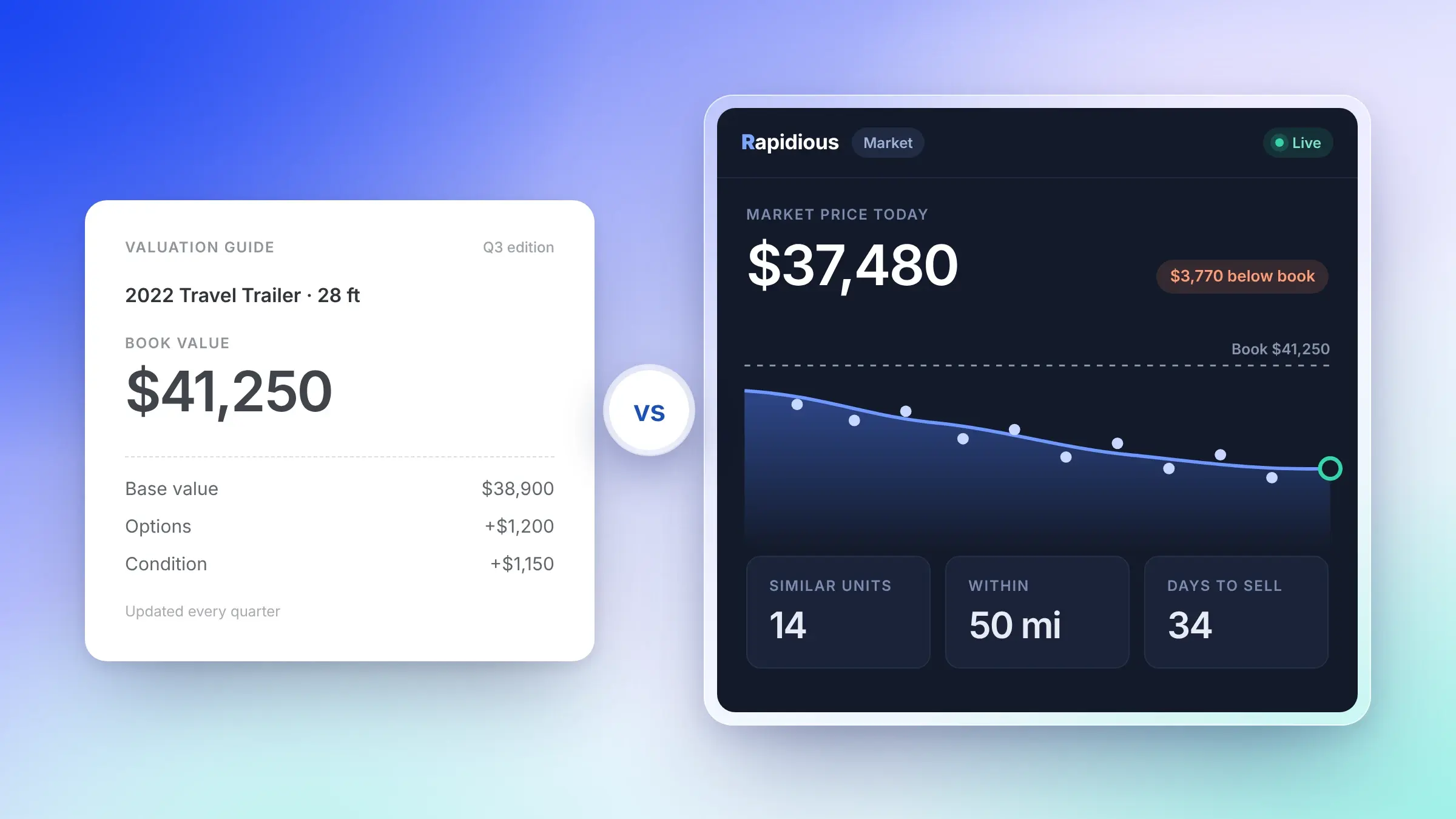
When a used RV comes in on trade, a dealer usually needs two answers: what the unit is worth as a reference value, and what comparable units are bringing in their market right now. A valuation guide is built for the first question, and RV market intelligence is built for the second. Many dealers use both.
What is the difference between a valuation guide and RV market intelligence?
A valuation guide gives a published reference value for an RV, while RV market intelligence shows how comparable RVs are listed and moving in a specific market. The two draw on different data and tend to support different decisions.
What is a valuation guide?
A valuation guide is a published reference of RV values by year, make, model and options, with adjustments for equipment and, in some cases, condition. Dealers, lenders, insurers, F&I teams and many consumers use it as a shared reference point.
What is RV market intelligence?
RV market intelligence is a platform that tracks retail RV listings across dealer rooftops. It shows listed prices, the number of comparable units, days on lot and units that appear to have sold, and is often refreshed daily. Three terms used in this comparison:
- Listed price: the asking price shown in a dealer's public listing. It may differ from the final selling price.
- Days on lot: the number of calendar days a unit has been publicly listed for sale, counted from the day the listing first appears online until it stops appearing.
- Sold signal: a unit that was listed and then stops appearing is inferred as sold. This is an estimate based on listing data, not a confirmed sale or a final selling price.
When is a valuation guide useful?
A valuation guide tends to be most useful when a deal needs a value that other parties already recognize.
- Financing and F&I: lenders often tie loan-to-value and approval decisions to guide values.
- Customer conversations: many customers recognize guide values, which can make a trade value easier to explain.
- Consistency: the same unit receives the same reference value, which supports internal policies, training and documentation.
- Options and equipment: standard adjustments help account for how a unit is equipped.
- A baseline: a guide value can serve as a starting point before a dealer looks at the local market.
When might a valuation guide not be the best fit?
A valuation guide may be less helpful when a decision depends on what is happening in a specific market right now.
- Local competition: a guide value does not usually show how many comparable units are listed nearby or at what prices.
- Fast-moving conditions: values change on the publisher's schedule, so recent local shifts may not be reflected yet.
- Time to sell: guides do not usually track days on lot or how quickly comparable units are selling.
- Stocking decisions: a guide value does not indicate whether a segment is oversupplied in a given area.
When is RV market intelligence useful?
RV market intelligence tends to be most useful when a pricing, appraisal or stocking decision depends on current local conditions.
- Setting a listed price: dealers can see how comparable units are priced in their market.
- Reviewing aging units: days on lot for comparable units can help a dealer decide whether a price review is worthwhile.
- Appraising trades and auction units: local supply and recent sold signals can inform an offer.
- Stocking: changes in supply and sold signals by segment can show where demand may be shifting in an area.
When might RV market intelligence not be the best fit?
RV market intelligence may be less suitable when a decision needs a recognized reference value or confirmed transaction data.
- Lending and insurance: lenders and insurers typically work from guide values rather than listing data.
- Final selling prices: the data is based on listed prices, and sold signals are inferred, so neither is a confirmed transaction price.
- Unusual units: rare or heavily customized RVs may have few comparable listings, which can make comparisons less reliable.
- Private-party sales: the data covers dealer listings, so private sales are generally not included.
How can dealers use both together?
Many dealers use a valuation guide as the reference point and RV market intelligence to see how the local market compares. A common appraisal workflow:
- Look up the guide value for the unit.
- Review listed prices, supply and days on lot for comparable units in the local market.
- Adjust the offer based on whether the local market appears to sit above or below the reference, and how quickly comparable units are moving.
- Use the guide value when explaining the offer to the customer or working with a lender.
Which tool fits which task?
Frequently Asked Questions
RV Market Intelligence, Delivered Weekly.
Actionable insights on pricing shifts, inventory velocity, competitive positioning built from market derived intelligence.






-
Heading 2
Heading 3
Heading 4
Lorem ipsum dolor sit amet, consectetur adipiscing elit, sed do
Ordered list
Unordered list
Text link
Bold text
Emphasis
-