
.jpeg)
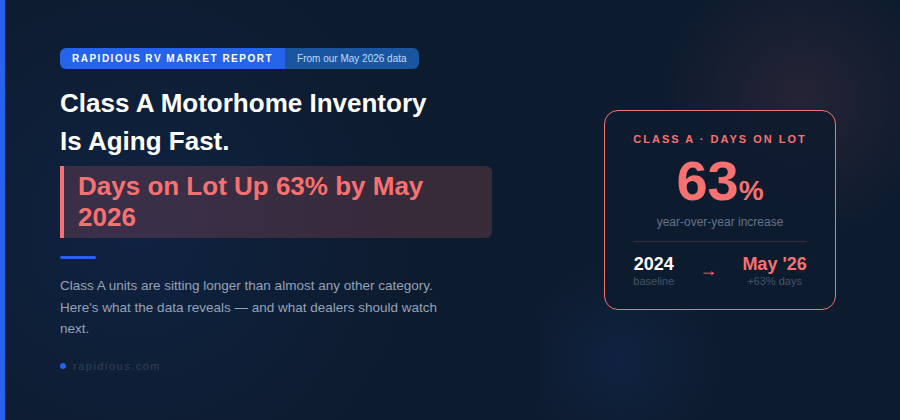
Class A Inventory Is Aging at an Accelerating Rate
Of all the segments Rapidious Titan.AI tracks, Class A motorhomes showed the sharpest deterioration in May 2026. Average days on lot rose from 179 days in February to 293 days in May, a 63% increase in just three months.
That's not a seasonal blip or a temporary dip in demand. It's a structural shift in how long this segment is sitting before it sells, and it's happening faster than most dealers have had time to react to.
To put that number in context: a unit at 179 days on lot is already past the point most dealers would consider "fresh," but it's still within a window where a moderate price adjustment can move it without major margin loss. A unit at 293 days has crossed into territory where the only remaining lever is often a steep discount, the kind that erases months of carrying cost in a single transaction. The jump from one to the other in just three months means a meaningful share of Class A inventory crossed that threshold during this period, often without a corresponding pricing response.
This pattern tends to compound. Units that age past 180 days don't just sit quietly, they accumulate floorplan interest, take up physical lot space that could turn over with fresher inventory, and often require deeper markdowns the longer they remain unsold. A dealer carrying ten aging Class A units isn't facing one problem; they're facing ten compounding ones, each on its own clock.
What This Means for Dealers
If you're carrying Class A inventory right now, the data suggests reviewing pricing on any unit that has crossed 90 days, not waiting until it hits 180 or beyond. Early, smaller price corrections protect more margin than late, larger ones. It's also worth segmenting your Class A inventory by age band (0 to 90, 90 to 180, 180+) rather than looking at it as one undifferentiated category, since the right action differs sharply across those bands.
What This Means for OEMs
For manufacturers, this trend is a signal worth watching closely on two fronts. First, if dealer lots are holding Class A inventory significantly longer, that has direct implications for future wholesale order volume, since dealers managing an aging glut are less likely to take on new allocation until existing stock clears. Second, sustained aging at this rate may indicate a broader supply-demand imbalance in the Class A segment specifically, which could warrant a closer look at production planning and incentive structures for this category relative to others that are moving faster.
What the Class A numbers really argue for is timing. When a segment ages this fast, the dealers who hold their margin are the ones repricing to the live market early, and that is getting hard to do with a number that updates on a lag.
Data sourced from Rapidious Titan.AI, a real-time RV market intelligence platform. Based on U.S. dealer inventory tracked daily through May 2026.

.svg)


-
Heading 2
Heading 3
Heading 4
Lorem ipsum dolor sit amet, consectetur adipiscing elit, sed do
Ordered list
Unordered list
Text link
Bold text
Emphasis
-