

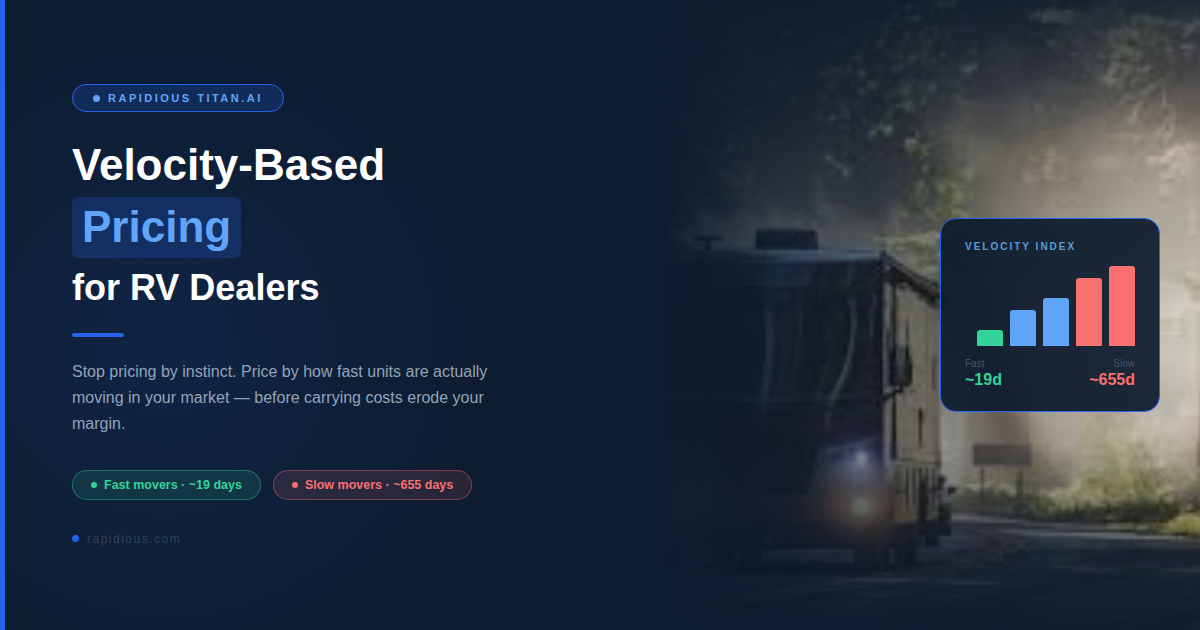
Every RV on your lot has two clocks running: the price you set, and the time it takes to sell. Most pricing methods only watch the first. Velocity-based pricing watches both, and in today's RV market that is the difference between a unit that turns and one that quietly drains floorplan for six months.
Here is what velocity-based pricing for RV dealers actually means, why it matters now, and how Rapidious Titan.AI puts it to work.
What is velocity-based pricing?
Velocity-based pricing is setting a unit's price around how fast it should sell, not just what it is broadly worth. Instead of pricing only to a static valuation guide, you factor in sales velocity, local supply, and how quickly comparable units are actually clearing, then set a price that moves the unit at a healthy margin.
The key metric is sales velocity: the real days-to-sale for a specific year, make, model, and floorplan in your market. A fast mover can hold a firmer price because demand will carry it. A slow mover needs a sharper price up front, before it ages. Pricing each unit to its own velocity, on purpose, is the whole idea.
It is the same principle auto dealers have used for years, where velocity pricing reshaped how used inventory gets priced. RV dealers are now adopting it, adapted for how RV inventory actually moves.
Why velocity-based pricing matters for RV dealers now
The RV market has slowed and spread out. According to Rapidious data from "The Great Inventory Reckoning," only about 45 percent of units sell within 90 days, while roughly 55 percent take more than 100 days and a significant share sit past 180. New units now sell at average discounts above 30 percent off sticker, and slower segments like Class A motorhomes turn more slowly still. The same model can clear in about 132 days in Arizona and take 174 in Montana.
In that market, a price that ignores velocity is a price that ignores aging risk. A unit priced a little high in a slow segment does not just sell for slightly less later, it sells much later, after carrying cost and a deeper markdown have already eaten the gross.
How velocity-based pricing works, step by step
- Read the turn. Know the real days-to-sale, the sales velocity, for the unit in your market, not a national average.
- Check local supply. Understand how many comparable units are nearby and how deep the days of supply runs, because that drives how much pricing room you have.
- Price to the velocity. Set the number against how fast the unit should move, and see where your price ranks among comparable units selling near you.
- Act early. Reprice a slow unit at day 30, when a small adjustment still works, rather than discounting hard at day 150 when it does not.
The hard part is the data. Sales velocity, days of supply, and local competitive pricing are not in a valuation guide, because the guide is built on history. They have to be read from the live market.
How Rapidious Titan.AI powers velocity-based pricing
Rapidious Titan.AI is a real-time RV market intelligence platform built to make velocity-based pricing practical, unit by unit. It tracks the live RV market daily and turns it into the numbers a dealer needs to price to turn:
- Sales velocity. Every unit is classified by its real days-to-sale, from rapid through slow, based on recent comparable sales, so you know how fast a specific year, make, model, and floorplan is actually moving.
- Days of supply. How long current inventory of that unit will take to clear at the current pace.
- Market price and where you rank. The market median price for the unit and where your price sits against comparable units selling near you.
- An ideal price range. Derived from the unit's velocity and current supply: a fast seller can hold a higher price for margin, a slow seller needs a cut to clear.
- Radius-based competition. Comparable units within a radius you choose, for example 250 or 500 miles, and how many are priced above or below you, because a dealer down the road matters more than the national number.
- Reprice flags. Overpriced, slow-moving units are surfaced early, so you can act at day 30 instead of day 150.
Put together, that is velocity-based pricing made operational: the live-market read that tells you not just what a unit is worth, but how fast it will move at that price. It is built to support the dealer's judgment, not replace it, putting the live market in front of the person setting the price instead of a guess.
Velocity-based pricing and the valuation guide
Velocity-based pricing does not retire the valuation guide. A guide still gives a defensible baseline and a shared reference for lenders and insurers. Velocity-based pricing adds the dimension the guide cannot carry: time. The guide tells you what a unit is broadly worth. Sales velocity tells you how fast it will move at that price, and whether the number needs to change before the unit ages. Anchor with the guide, price to the velocity.
Common questions
What is velocity-based pricing for RV dealers?
It is pricing each unit around how fast it should sell, using sales velocity and live market data, rather than pricing only to a static valuation guide. The goal is to price to turn at a healthy margin instead of letting units age.
Is this the same as the velocity pricing auto dealers use?
It is the same core idea, adapted for RV. Auto dealers have priced to days-on-market and live market data for years. RV velocity-based pricing applies that to how RV inventory moves, with longer cycles and more varied segments.
What data do you need for velocity-based pricing?
Sales velocity (real days-to-sale), days of supply, and what comparable units are actually selling for near you. Rapidious Titan.AI reads all three from the live market daily.
Does velocity-based pricing replace a valuation guide?
No. Use the guide to anchor a defensible baseline, then use sales velocity and live market data to set the price that actually moves the unit.
The bottom line
In a slower, more local RV market, the price on the tag and the time to sell are the same decision. Velocity-based pricing for RV dealers makes that decision on purpose, and Rapidious Titan.AI is the real-time RV market intelligence platform that gives you the sales velocity, supply, and local pricing to do it, unit by unit, before a unit ages.


.svg)


-
Heading 2
Heading 3
Heading 4
Lorem ipsum dolor sit amet, consectetur adipiscing elit, sed do
Ordered list
Unordered list
Text link
Bold text
Emphasis
-