

Where Does Your Lot Actually Stand?
Listed value and real selling price aren't the same. See if your lot is overpriced, underpriced or sitting for longer than it should be.
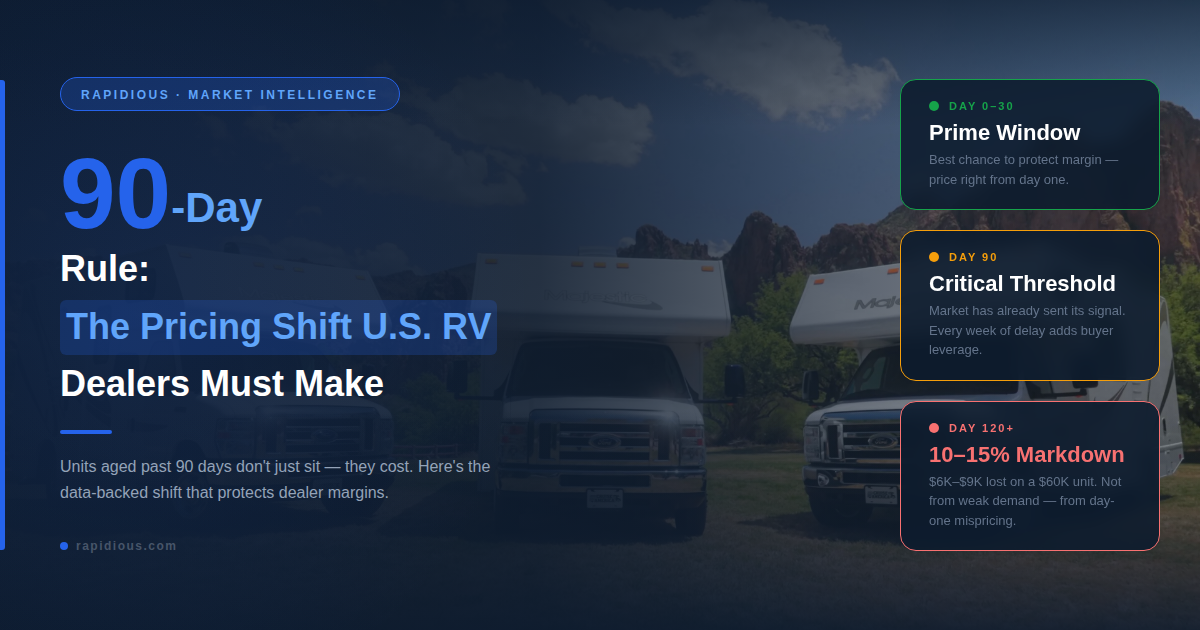
With RV inventory aging at record highs and more than $6.48B in RV units sitting past 90 days, based on Rapidious market data tracking inventory across U.S. dealerships, the 90-Day Rule is no longer a best practice; it’s a survival strategy.
For U.S. RV dealers, applying this rule determines whether you protect margins, control depreciation, and maintain healthy inventory turnover, or get buried in floor plan interest, stale stock, and shrinking demand.
What Is the 90-Day Rule, And Why So Many RV Dealers Ignore It?
The rule is straightforward:
If an RV hasn’t sold by Day 90, it’s costing your dealership money — every single day.
But many dealers treat 90 days like a suggestion, not a deadline. In 2025’s competitive RV retail environment, Day 90 is the cliff. Here’s why:
1. Carrying Costs Skyrocket After Day 90
Most RV dealers pay around 1% of unit value per month in:
- Floor plan interest
- Insurance
- Lot space
- Marketing
- Depreciation
That means:
- $100,000 motorhome over 90 days → $1,000/month loss
- $50,000 travel trailer over 90 days → $500/month loss
Multiply that across your lot and you’re looking at tens of thousands in silent losses.
2. Days on Lot Is Now the #1 Predictor of Margin Loss
Rapidious inventory tracking data shows new RVs are averaging 195 days on lot nationally, while used RVs sell 67% faster. These figures come from real-time monitoring across U.S. dealerships.
Every day an RV sits:
- Gross margin shrinks
- Price-to-market drifts out of alignment
- Leads cool
- Sales teams stop prioritizing the unit
By Day 90, your odds of selling at asking price are nearly zero.

3. Model Year Depreciation Accelerates Rapidly
2025 models are already averaging 219+ days on lot, and 2026–27 models are arriving fast.
This creates:
- Daily value drops
- Stale “aged new” units
- OEM incentives that undercut your pricing
- Forced liquidation just to free floor plan
Allowing a 2025 RV to cross 90–120 days is one of the most expensive mistakes a dealership can make.
Why the 90-Day Rule Is the New Gold Standard in U.S. RV Dealerships
Top-performing dealers, especially in Florida, Texas, Utah, Idaho, and Colorado — follow this rule religiously because it drives:
Faster Inventory Turnover
Dealers achieving 3x+ turns per year significantly outperform the 1.85x national average.
Lower Floor Plan Risk
Tightening lenders favor dealers with fast-moving inventory.
Higher Cash Flow + Greater Buying Power
Dealers with liquidity can capitalize on:
- OEM incentives
- Seasonal buying spikes
- High-demand categories (Class B vans, lightweight towables)
Aging stock kills these opportunities.
How RV Dealers Should Reprice Units Before They Hit 90 Days
Most dealers start discounting too late. Here’s the data-backed pricing roadmap:
0–30 Days: Hold Gross & Maximize Exposure
Your premium selling window.
Actions:
- Price-to-market: 98–102%
- “Just Arrived” merchandising
- Boost photos & video walk-throughs
- Target high-intent seasonal buyers
31–60 Days: Make Micro-Adjustments
Small changes prevent major losses later.
Actions:
- Adjust price by 1–3%
- Offer small incentives (hitch, prep kit, accessories)
- Rotate lot position
- Increase ads on high-margin units only
61–89 Days: Strategic Pricing Reset
This is the critical correction window.
Actions:
- Price-to-market: 95–98%
- Add value bundles
- Shift inventory to high-velocity states
- Refresh photos & listing content
90+ Days: Act Decisively or Lose Margin
At this point, the RV becomes a cost center.
Actions:
- Price-to-market: 90–95%
- Liquidate 2023 and older units
- Wholesale anything over one year old
- Request OEM support: co-op, aging relief
- Push “manager’s specials”
Waiting “to see if it sells” is the most expensive mistake dealers make.

Why Used RVs Also Need the 90-Day Rule
Although used RVs sell 67% faster, they:
- Lose value with every trade
- Require more reconditioning
- Shift with fast-changing demand
The 90-day window is your last chance to preserve margin.
What Successful RV Dealers Are Doing in 2025
1. Daily price-to-market monitoring
Weekly updates are no longer enough.
2. Aggressive action on aging 2025 units
Especially those 180+ days old.
3. Inventory transfers to high-demand regions
FL, TX, UT, ID, CO continue to outperform.
4. Data-backed pricing & merchandising
Dealers rely on real-time competitive data and velocity insights.
How Rapidious Titan.AI Supports the 90-Day Decision
Most dealerships already know aging inventory is expensive. The harder problem is catching it early - before a unit crosses the threshold where margin recovery becomes difficult.
Without a complete view of the market, it is easy to hold a unit too long, miss the window to reprice it, or misjudge what comparable units are actually selling for nearby. That gap is where margin leaks.
Rapidious Titan.AI gives dealers the live market context to make that call with confidence:
- Aging and turn data by VIN - so slow-moving units surface before they become a floorplan problem, not after
- Live price-to-market benchmarking against competing rooftops in your region - updated continuously, not weekly
- Real transaction data on what comparable units actually sold for and how fast - not asking prices from listing sites
- Local, regional, and national market context in one dashboard - so pricing and appraisal decisions are grounded in what the market is actually doing
The 90-Day Rule works when dealers have the right data to act on it at the right time. Rapidious Titan.AI is built to support exactly that.
The 90-Day Rule Is No Longer Optional
With more than $778 million lost annually from aged inventory, based on Rapidious analysis of national RV dealership data, the 90-Day Rule is the only system protecting dealerships from the 2025–2027 model-year squeeze.
- At Day 60 → You still have time.
- At Day 90 → You’re losing money.
- At Day 180 → It’s an emergency.
Dealers who enforce the 90-Day Rule today will dominate their markets tomorrow.
Rapidious tracks inventory velocity, price-to-market alignment, and aging risk across U.S. RV dealerships in real time. See how it works → rapidious.com
RV Market Intelligence, Delivered Weekly.
Actionable insights on pricing shifts, inventory velocity, competitive positioning built from market derived intelligence.


.svg)






-
Heading 2
Heading 3
Heading 4
Lorem ipsum dolor sit amet, consectetur adipiscing elit, sed do
Ordered list
Unordered list
Text link
Bold text
Emphasis
-