


Where Does Your Lot Actually Stand?
Listed value and real selling price aren't the same. See if your lot is overpriced, underpriced or sitting for longer than it should be.
Market intelligence software helps RV dealerships price units more accurately, reduce floorplan costs, and avoid aging-inventory markdowns. It uses live sales, market velocity, and inventory-age data to guide pricing and trade appraisals.
The real ROI comes from daily decisions: repricing sooner, taking smarter trades, and putting inventory dollars where they perform best. Rapidious Titan.AI supports that process as a real-time RV market intelligence platform
The mistake is treating market intelligence as a reporting tool. It should be treated as an operating discipline.
What Market Intelligence Actually Gives You
Why do similar RVs sell at different speeds? Dealers who spot market shifts sooner can protect margin before floorplan costs rise.
Market intelligence software tracks competitive inventory, sales activity, velocity, time-to-sell, inventory age, and local market conditions, giving a clearer read on demand than asking prices alone. Rapidious Titan.AI, the real-time RV market intelligence platform helps turn that data into faster, smarter pricing decisions.
It Doesn't Work the Same Way for Every Unit
Not every unit on your lot behaves the same way in a market-intelligence tool, and it's worth being direct about that before going further.
- New vs. used: New-unit pricing is driven as much by MSRP, invoice, manufacturer incentives, and holdback as it is by what the lot down the road is asking. Used-unit pricing leans much more heavily on comparables, condition, and how fast similar units are actually moving — which is where this kind of software tends to earn its keep fastest.
- Motorized vs. towable: A Class A or C motorhome carries a higher floorplan cost, a slower typical turn, and a thinner comp pool than a travel trailer in the same price range. Fewer directly comparable units means the software has less to work with, so a recommendation on a motorized unit deserves more scrutiny than one on a towable.
- Comp density by market: In a dense RV market, there's usually enough nearby inventory for a tight, reliable comparison. In a smaller or rural market, the comp pool for a specific floorplan, year, and condition can be thin — ask any vendor directly how the tool handles a market with little to compare against.
From Understanding the Market to Adaptive Pricing
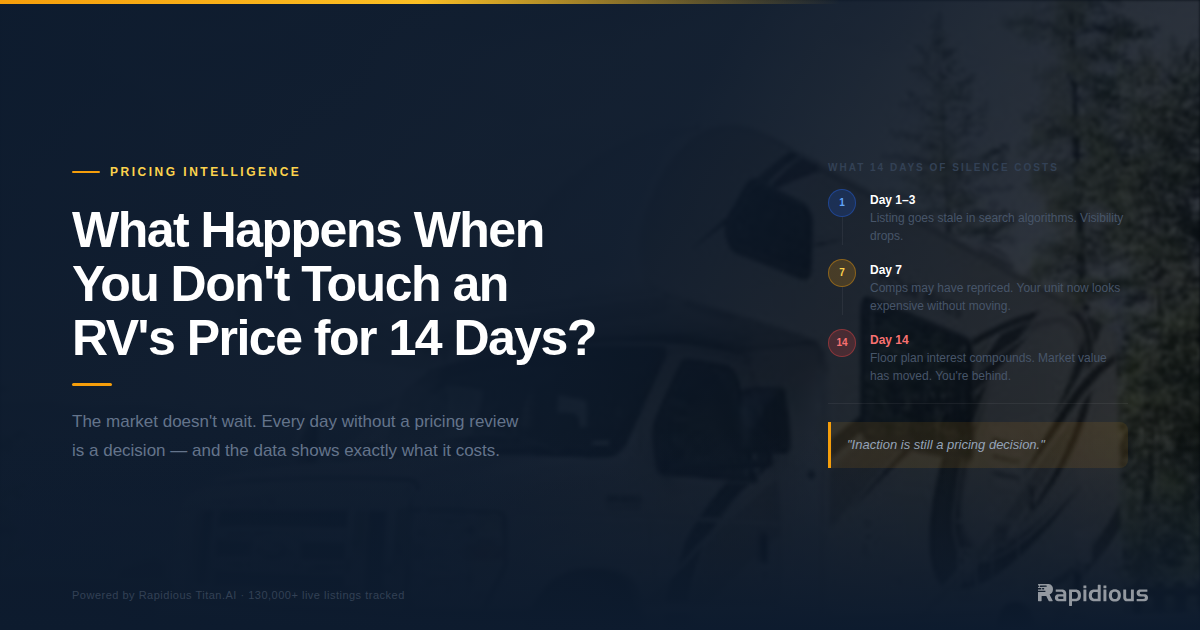
Seeing the market clearly is only the first step. Dealers can track competitive inventory and sales velocity and still be slow to act on it.
That next step is adaptive pricing: using market signals, inventory data, and margin goals to recommend a specific price for each unit and keep updating it as conditions change. Rapidious Titan.AI, the real-time rv market intelligence platform turns that data into a unit-level pricing recommendation, so a 70-day-old travel trailer can be repriced based on current comp movement, aging thresholds, and clearance goals.
The result is a specific action, not just a market snapshot.
Where the ROI Actually Comes From
The ROI math
It comes down to five things happening more consistently, not one big number.
- Fewer floorplan days — units spend less time sitting on the lot before they sell.
- Smaller, earlier pricing corrections — instead of the emergency markdown that comes once a unit is visibly stale.
- Better trade appraisal discipline — fewer trades taken in over market that quietly erode margin before a unit ever reaches the lot.
- Less manual comp-shopping — staff time no longer spent pulling competitor listings and comparables by hand.
- More consistent pricing across rooftops — the same aging unit isn't priced differently depending on which store is looking at it.
None of this shows up as a single line item, and it's worth being honest that the size of the effect varies a lot by dealership — there isn't a universal number that applies evenly across a single-rooftop used lot and a five-location group carrying new motorized inventory. What's consistent across dealerships that see a real return is the mechanism: catching a unit that's drifting out of its market window at day 30 instead of day 90 means a smaller correction, sold sooner, at a better margin than the markdown that would otherwise happen once the unit is visibly stale.
RAPIDIOUS ANALYSIS
A good price correction a month — catching a single aging unit before it needs an emergency markdown — can be enough to cover the cost of the platform for the entire year.
The same mechanism applies on the buy side. Appraisals are one of the highest-stakes pricing decisions a dealer makes, and one of the easiest places to lose margin without noticing — a trade taken in slightly over market, on a unit that then sits, compounds floorplan cost and markdown risk before it ever reaches the lot. The same market signals that inform a listing price inform an appraisal: what comparable units are actually selling for, how fast they're moving, and where this specific floorplan sits in its depreciation curve right now, not what a static guide said six months ago.
Dealerships that already run a disciplined, well-resourced manual pricing process tend to see a smaller swing — for them, the platform mainly saves time rather than uncovering money left on the table. Dealerships pricing more reactively, without a consistent way to translate market movement into unit-level decisions, tend to see the bigger shift, simply because there's more room to close the gap between what a unit is priced at and what the market — and the dealer's own goals — actually support.
Who Feels This Most
It is also not for every operator in the same way. A very small dealer with limited inventory and a narrow local market may value time savings more than pricing optimization. A multi-location dealer, a used-heavy store, or a motorized dealer carrying higher-dollar units will usually feel the financial impact more directly.
How Do You Know If This Applies to You?
A few questions worth asking honestly before deciding either way:
- Are we repricing aging units before they need an emergency markdown, or after?
- Do we know, right now, how our comparable units are actually moving — not just what they're listed for?
- Are our appraisals grounded in what units are selling for today, or a book value from months ago?
- Is pricing consistent across every rooftop, or does it depend on who happens to be looking at the unit that week?
Dealers using Rapidious Titan.AI can answer every one of these questions from a single dashboard — competitive inventory, sales velocity, time-to-sell, inventory age, and an ongoing, unit-level price recommendation that updates as conditions change.
The Real Risks Worth Knowing About
The risks, honestly
None of these are reasons to skip this — they're what separates dealerships that get real ROI from ones that just add another subscription.
- Adoption risk. Market intelligence — and the pricing recommendations built on it — only helps if pricing managers and GMs act on it. A tool that gets checked occasionally but ignored in daily decisions won't move the numbers.
- Signal quality and comp density. Recommendations are only as good as the competitive inventory, historical market activity, sales velocity, time-to-sell, and inventory age data behind them. Ask any vendor directly how current and how local their comparables are, how asking-price data is weighted against actual sale data, and how the tool handles thin comp pools — motorized units and rural markets in particular. National averages can mask what's happening in your specific radius.
- Seasonality. RV demand moves hard by season — spring buying season, winter slowdown, snowbird migration in southern markets. A drop in sales velocity in December isn't the same signal as a drop in June, and a dealer should understand whether a tool's recommendations account for normal seasonal patterns or read every slow month as market softening.
- Cost relative to dealership size. For a small, single-rooftop dealer with low inventory turn, the math may be closer than it is for a multi-location group. It's worth running the numbers for your specific volume and mix rather than assuming the case is identical everywhere.
- Over-reliance without judgment. Market intelligence and adaptive pricing work best as an input to a GM's decision, not a substitute for it. Local relationships, unit condition, and a read on the customer in front of you still matter — the recommendation narrows the guesswork, it doesn't remove the person making the call.
What to Actually Expect in the First 90 Days
Don't expect an overnight turnaround. Most dealerships move through the same three phases:
- Setup and interface familiarity — the first few weeks.
- Building trust in the recommendations — checking them against units the team already knows well.
- An actual shift in pricing habits — once the team trusts the recommendation enough to act on it without double-checking every time.
How fast that plays out depends on what you sell. Fast-turning towables give you a full sales cycle — and a chance to see whether the recommendations held up — well inside 90 days. Slower-moving motorized inventory takes longer simply because there are fewer transactions to validate against; a dealer carrying mostly Class A or C units should expect phase two to run closer to the far end of that 90-day window, or past it.
Pro tip: The dealerships that see results fastest build repricing reviews into a weekly routine from day one, rather than treating the platform as something to check only when things get slow.
Frequently Asked Questions
What's the difference between market intelligence and adaptive pricing?
Market intelligence is the visibility — competitive inventory, historical market activity, sales velocity, time-to-sell, inventory age, and local and regional market dynamics. Adaptive pricing is what happens next: turning those signals, together with a dealer's own inventory and goals, into an ongoing, unit-level pricing recommendation, rather than leaving the dealer to interpret the market data alone.
Does this kind of software replace the need for an experienced GM?
No. It gives GMs current, dealer-specific market data and pricing recommendations so decisions are based on today's conditions rather than memory or instinct. The judgment still belongs to the GM.
Does this help with trade appraisals, or just listing prices?
Both draw on the same underlying data. The market signals that inform where to list a unit — comparable sales, time-to-sell, depreciation trend — are the same ones that inform what a trade is actually worth right now, which matters because an over-appraised trade creates the same margin and floorplan problems as an overpriced listing, just earlier in the unit's life on the lot.
How quickly should a dealer expect results?
Not overnight. The first 30–90 days are about setup, trust-building, and building repricing habits.
What should dealers ask before choosing a vendor?
Ask how local the comps are, how often recommendations update, how thin comp pools are handled, and whether the tool supports daily workflow or just reporting.
Where Rapidious Titan.AI Fits
Everything above requires one thing to actually happen: turning today's market signals into a specific decision, on a specific unit, every day — not once a quarter. That's the gap Rapidious Titan.AI is built to close.
- Tracks competitive inventory, sales velocity, time-to-sell, and inventory age across your market — so pricing meetings start from a current picture instead of a manual pull of competitor listings.
- Turns those signals into an ongoing, unit-level price recommendation — so a unit gets repriced before it needs an emergency markdown, not after.
- Applies the same signals to trade evaluations — so an appraisal reflects what units are actually selling for today, not a static guide from months ago.
- Updates recommendations as conditions change — so pricing stays consistent across every rooftop in a multi-location group, not just the one someone happened to check that week.
The problem this article opened with — floorplan interest, markdowns, and inconsistent pricing quietly outrunning the cost of doing something about it — is exactly what Rapidious Titan.AI is built to solve.
See It on Your Own Inventory
The fastest way to know if this is worth it for your dealership is to see it against units you already have on the lot. Request a walkthrough with Rapidious and understand your dealership market better.
RV Market Intelligence, Delivered Weekly.
Actionable insights on pricing shifts, inventory velocity, competitive positioning built from market derived intelligence.


.svg)






-
Heading 2
Heading 3
Heading 4
Lorem ipsum dolor sit amet, consectetur adipiscing elit, sed do
Ordered list
Unordered list
Text link
Bold text
Emphasis
-