

Where Does Your Lot Actually Stand?
Listed value and real selling price aren't the same. See if your lot is overpriced, underpriced or sitting for longer than it should be.
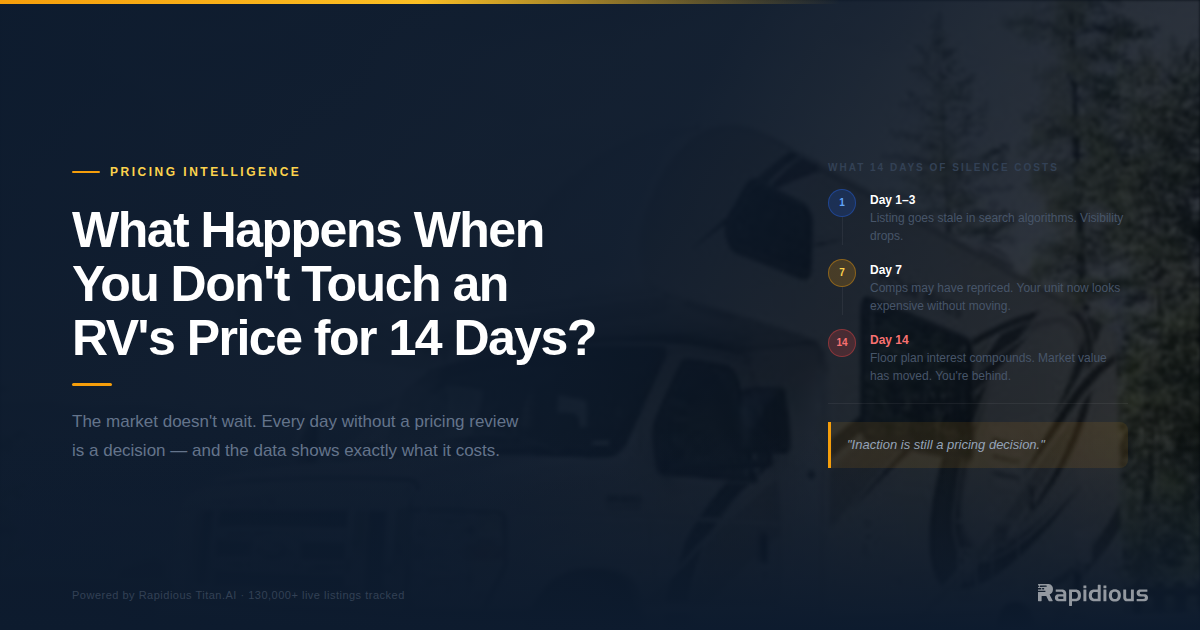
"Set it and forget it" feels safe. You priced the unit right when it hit the lot, so why keep touching it? The problem is that the price stands still while the market underneath it doesn't. A price that was competitive two weeks ago isn't competitive because you set it well — it's competitive only until the market moves. And the market moves constantly.
The market moves under a static price
RV velocity can shift fast. According to Rapidious Titan.AI data, Class A motorhomes went from selling in about 143 days to 286 over a single summer in 2026 — the market didn't ease off, it changed shape. As comparable units sell and new ones list, the market-clearing price for a given unit resets continuously. A price you haven't touched in two weeks was set for conditions that may no longer exist.
Look at how far segments moved in a single quarter:
If the market can shift this much in three months, it moves meaningfully in two weeks — which is exactly how a price you set and forgot drifts out of position without a single number changing.
The unit doesn't announce this. It just starts getting fewer looks, because buyers comparing it against fresher, better-positioned comps quietly move on. The sticker didn't change — the world around it did.
The cost compounds while you wait
Every week a stale price sits, two things work against you. First, carrying cost — floor-plan interest and depreciation — ticks up regardless. Second, the gap between your price and the live market tends to widen, because the market keeps moving and your price doesn't. Left long enough, "set it and forget it" turns into "cut it deep later" — the exact large, defensive markdown you were trying to avoid. A price that drifts is a price you'll eventually pay to correct.
So how often should you reprice?
Not constantly — that's just chasing the market and signaling weakness. But not never, either. The practical middle is a regular cadence: review each unit against live comparable activity on a set rhythm — every couple of weeks is a reasonable default in most segments, more often in fast-moving ones — and move a price only when the market has actually moved. The discipline isn't frequent cutting; it's frequent checking, so you act on real change instead of drift.
Repricing isn't the same as discounting
Worth being clear: repricing means realigning a unit to where the market actually is — which can mean holding, and occasionally even raising, not only cutting. Discounting means going below the market to force a sale. A dealer who reprices on a cadence discounts less, not more, because units never drift far enough out of position to need a deep, panicked cut.
How Rapidious Titan.AI helps
The reason stale pricing happens isn't laziness — it's that re-checking every unit against the live market by hand is impossible on a busy lot. Rapidious Titan.AI flags which units have drifted out of position since their price last changed, so a stale price becomes something you can see and fix on a rhythm, not a surprise you discover when the unit's already aged.
Dealers can get a free, personalized lot report from Rapidious that shows how their own inventory is priced and how fast it's turning against the live market — a look at where your lot stands, not just the market average.
Frequently asked questions
How often should I reprice RV inventory?
On a regular cadence rather than constantly — reviewing each unit against live comparable activity every couple of weeks is a reasonable default, more often in fast-moving segments. Move a price when the market has actually moved, not on a fixed calendar.
Does leaving a price alone actually hurt sales?
It can. A price doesn't have to be wrong to stall a unit — as the market shifts, an untouched price drifts out of position and the unit quietly gets fewer looks against fresher comps.
Is repricing the same as discounting?
No. Repricing realigns a unit to the current market and can mean holding or raising, not only cutting. Discounting goes below market to force a sale. Repricing regularly usually means discounting less.
The point
A price is a decision the market keeps re-grading. Leave it untouched for two weeks and it can drift out of position without a single number changing — and the longer it drifts, the bigger the correction later. Check often, move deliberately, and you keep units in position instead of paying to rescue them.
Data & methodology: Figures drawn from Rapidious Titan.AI market intelligence covering U.S. RV dealer listings and sales, 2026. Repricing cadence is a practical recommendation, not a measured figure. Verify current data before publishing.
RV Market Intelligence, Delivered Weekly.
Actionable insights on pricing shifts, inventory velocity, competitive positioning built from market derived intelligence.



.svg)






-
Heading 2
Heading 3
Heading 4
Lorem ipsum dolor sit amet, consectetur adipiscing elit, sed do
Ordered list
Unordered list
Text link
Bold text
Emphasis
-