

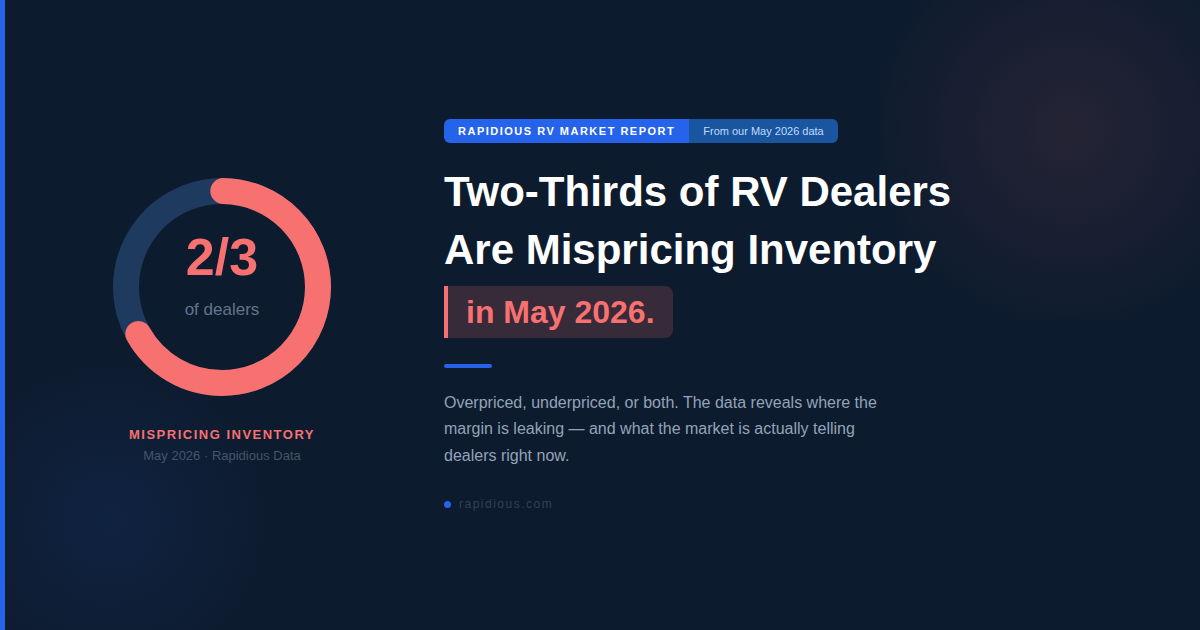
Two-Thirds of Dealers Are Pricing Away From the Market
Rapidious Titan.AI's May 2026 pricing data reveals a pattern that should concern any dealer relying on traditional pricing references: 66% of RV dealers are currently listing inventory above the Rapidious Titan.AI market benchmark, with an average gap of $807 per unit. That gap isn't uniform, on the high end, some Class A units are priced more than $80,000 above what the market is actually clearing them at, a discrepancy large enough to keep a unit parked indefinitely regardless of how strong demand might otherwise be for that model.
The mispricing pattern isn't purely one-directional, which makes the finding more interesting and more actionable. A 2024 Newmar Ventana in the Rapidious Titan.AI dataset was listed at an average of $134,000 below its market benchmark, meaning some dealers are leaving substantial margin on the table by underpricing relative to what buyers are actually willing to pay. Both extremes point to the same underlying issue: pricing decisions disconnected from real-time transaction data.
What connects these cases, overpriced and underpriced alike, is the absence of a live reference point. Book values smooth over months of data and update on a lag. Dealer intuition, however experienced, can't track 130,000+ units nationally the way the Rapidious Titan.AI live market model can. The result is a market where two-thirds of participants are pricing against an outdated or incomplete picture, and the gap between listed price and actual transaction price becomes a quiet, ongoing cost that rarely shows up clearly in monthly reporting.
What This Means for Dealers
The 66% figure means mispricing is closer to the norm than the exception right now. The actionable step is auditing current listings against live market data rather than assuming book value or last quarter's pricing still applies. Both overpricing and underpricing carry real costs: overpriced units sit and accumulate carrying costs, underpriced units close deals at avoidable margin loss. A regular pricing review cadence, ideally weekly rather than monthly, would catch both before they compound.
What This Means for OEMs
For manufacturers, widespread pricing misalignment at the dealer level distorts the signal OEMs get about true model demand. A unit that isn't selling because it's mispriced looks identical, from the outside, to a unit that isn't selling because demand genuinely isn't there. This matters for forecasting and allocation: OEMs may be drawing conclusions about model popularity that are actually artifacts of dealer pricing behavior rather than real market signal.
Underneath the 66 percent is a simple shift: when the market reprices itself week to week, pricing in real time stops being an advantage and starts being the cost of keeping up.
Data sourced from Rapidious Titan.AI, a real-time RV market intelligence platform. Based on U.S. dealer inventory tracked daily through May 2026.

.svg)


-
Heading 2
Heading 3
Heading 4
Lorem ipsum dolor sit amet, consectetur adipiscing elit, sed do
Ordered list
Unordered list
Text link
Bold text
Emphasis
-