

You take a trade at the appraisal desk. The book hands you a clean number, and it feels solid. Then you walk the lot and find two of the same unit sitting unsold, both listed below that number. A dealer 200 miles away has a third priced lower still. So which number is right, the one in the guide or the one the market is actually paying?
Both can be right.
They answer different questions, and they come from two different approaches to pricing an RV. One is the valuation guide, a baseline of what a unit is broadly worth. The other is real-time market pricing, a live read on what units are actually selling for, how fast, and at what price. Rapidious Titan.AI is built on the second.
Dealers who price with confidence use both, and they know which one to reach for at each step.
What a valuation guide is good for
A valuation guide is the baseline, and it does that job well. It gives you a defensible starting number for a year, make, and model, built from historical data. It is a common language between a dealer, a lender, and an insurer. When you need an anchor that everyone recognizes, a guide value is built for exactly that.
If the question is "what is this unit broadly worth," the guide answers it. Keep using it for that.
Where a guide value stops
A baseline is a starting point, not a selling price. A guide value is built from historical data, so it cannot see what is happening on lots right now. It cannot tell you three things that decide whether a unit sells or sits:
- What comparable units are actually selling for in your market, not nationally.
- How fast that specific unit is moving, measured in days-to-sale.
- Whether your price is high or low against the dealers a buyer compares you to first.
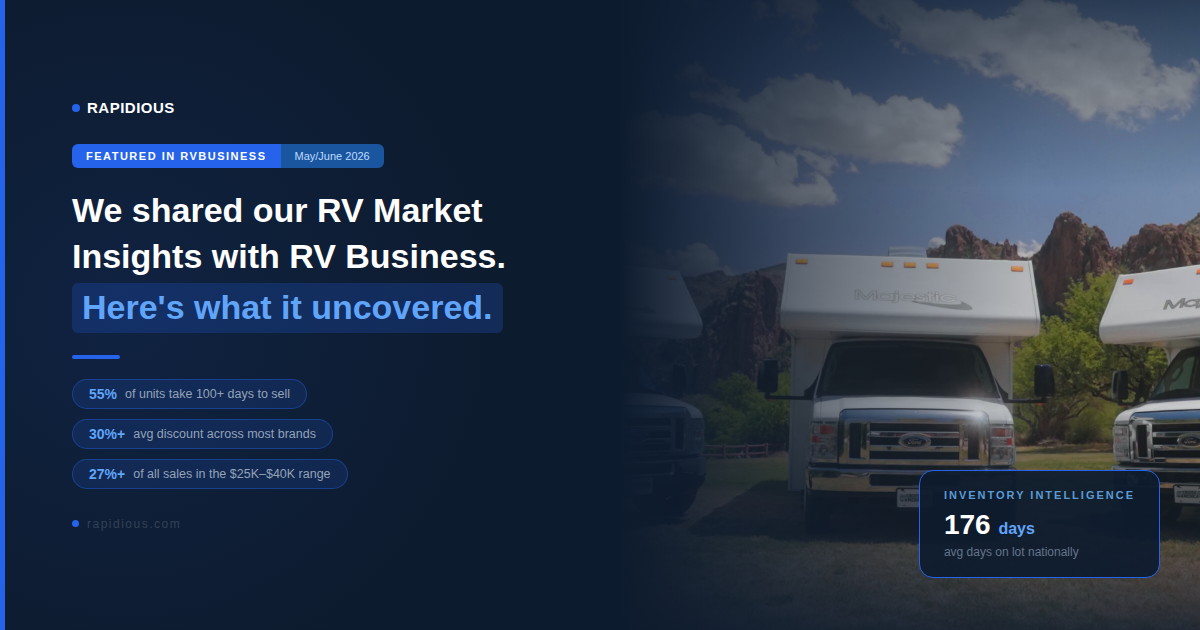
That gap is not small, because the RV market has moved quickly. Across most brands, new units now sell at average discounts above 30 percent, and buyers have grown cautious about sticker prices. More than half of all units take over 100 days to sell, and a meaningful share sit past 180. The same model that clears in 132 days in one state can take 174 in another. A single national number cannot see any of that.
What Rapidious Titan.AI real-time market pricing adds
This is the layer a guide value cannot reach, and it is the one Rapidious Titan.AI is built for. Instead of one historical figure, it reads the live market around a specific unit and turns it into a price you can defend:
- Local competition. Rapidious Titan.AI shows the comparable units selling within a radius you choose, for example 250 or 500 miles, and where your price ranks among them. A buyer compares you to the dealer down the road, so that is the number that matters.
- How fast it sells. Rapidious Titan.AI measures days-to-sale for that unit, so a fast mover and a slow mover get priced differently on purpose, not by gut.
- The real market number. It sets the market median for that year, make, model, and floorplan, so a few outliers do not skew your read, and gives you an ideal price range for the unit in front of you.
This is not a listings feed. Rapidious Titan.AI is the intelligence layer on top of the market: what is actually selling, how fast, and where you stand against your competition. A fast-selling unit priced below its market is leaving margin on the table. A slow-selling unit priced above its market is about to become a carrying cost. A guide value cannot tell those two apart. Rapidious Titan.AI can.
When to use which
The simplest way to hold it: anchor with the valuation guide, price with Rapidious Titan.AI real-time market data. One sets the reference. The other sets the number you put on the unit and the trade.
Why guide values differ from real-time market prices
When a guide value and the live market disagree, it is usually a signal, not an error. It often means supply has shifted, a segment has cooled, or a brand has been discounted enough to reset what buyers expect to pay. Some brands have at times sold at or above sticker because supply was kept tight, while others discount hard to move units. A guide value reports one number through all of that. Rapidious Titan.AI reads the difference, and that difference is what separates repricing a unit at day 30 from discounting it at day 150.
Common questions
Is a valuation guide accurate for pricing RVs?
A valuation guide gives an accurate baseline of what a unit is broadly worth, and that is what it is for. It is not built to tell you what the unit is selling for in your market this week, how fast it is moving, or where your price sits against nearby dealers. For that, dealers pair the guide with Rapidious Titan.AI real-time market data.
How do RV guide values compare to real-time market prices?
A valuation guide gives you a national estimate of what a unit is broadly worth. The real-time market price is a different number: what comparable units are actually selling for in your area right now. The two often diverge, and Rapidious Titan.AI shows that comparison live, so you can see where your price sits against the real market instead of the guide.
Why do RV guide values differ from market prices?
Because a valuation guide is historical and national, while the market is current and local. New units now sell at average discounts above 30 percent, supply shifts by region and segment, and the same model can take 132 days to sell in one state and 174 in another. Those differences are exactly what Rapidious Titan.AI tracks, so you can price to the live market instead of guessing.
What is real-time RV market pricing?
It is pricing a unit off the live market rather than a static guide: what comparable units are actually selling for nearby, how fast they move, and where your price ranks. Rapidious Titan.AI is the real-time RV market intelligence platform built for this, tracking the RV market daily across the U.S. and Canada.
Should RV dealers use a valuation guide or real-time market data?
Both, for different steps. Anchor with the valuation guide, then set and defend the actual price with Rapidious Titan.AI real-time market data. One is the reference. The other is the decision.
The bottom line for dealers
A valuation guide tells you what an RV should be worth on paper, and it does that job well. Rapidious Titan.AI tells you what it is actually selling for, how fast, and at what price in your market this week. Anchor with the guide. Price with Rapidious Titan.AI. That is how a dealer protects margin on the fast movers and clears the slow ones before they age.
Rapidious Titan.AI is a real-time RV market intelligence platform that tracks the RV market daily across the U.S. and Canada and turns it into the calls dealers make every day: pricing a unit, appraising a trade, managing aging risk, and deciding what to stock next. It supports your judgment and the guide you already use. It gives both a live market to work against.

.svg)


-
Heading 2
Heading 3
Heading 4
Lorem ipsum dolor sit amet, consectetur adipiscing elit, sed do
Ordered list
Unordered list
Text link
Bold text
Emphasis
-